Resistance of Nile tilapia leather subjected to pickling with different salt concentrations and exposure times of skins in salt-free water
DOI:
https://doi.org/10.21708/avb.2025.19.2.12832Abstract
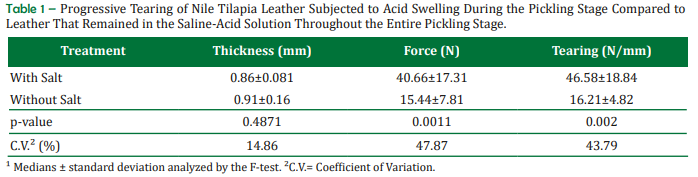
The skins discarded during the filleting process, when subjected to an appropriate tanning process, can be transformed into high-quality leather. Thus, the objective of this study was to analyze the effect of salt concentration and acid swelling as a function of the exposure time of Nile tilapia skins acidified in salt-free water. To this end, three tests were conducted: Test I – Evaluation of pickled skins; Test II – Evaluation of the effect of salt concentration in the pickling stage; and Test III – Evaluation of the effect of pickled skins at different exposure times in salt-free water. The removal of acidified skins to salt-free water promotes acid swelling, which can significantly reduce the leather’s resistance, tear strength, elongation, and tensile strength. A salt concentration below the recommended level leads to acid swelling, while an excessive concentration prevents proper tanning, resulting in collagen fiber densification. Regarding the exposure time of skins in salt-free water, significant losses in their properties were already observed after ten minutes. It is concluded that salt is essential in the pickling stage, requiring a Baumé degree of 7. Skins should not be exposed to a salt-free solution to prevent acid swelling, which compromises their resistance quality. Exposure to salt-free water can reduce elasticity, tensile strength, and progressive tearing, regardless of the exposure duration.
Dowloads
Pubblicato
Fascicolo
Sezione
Licenza
Copyright (c) 2025 Acta Veterinaria Brasilica

Questo volume è pubblicato con la licenza Creative Commons Attribuzione 4.0 Internazionale.
Autores que publicam na Acta Veterinaria Brasilica concordam com os seguintes termos: a) Autores mantém os direitos autorais e concedem à revista o direito de primeira publicação, com o trabalho simultaneamente licenciado sob a Licença Creative Commons Attribution que permite o compartilhamento do trabalho com reconhecimento da autoria e publicação inicial nesta revista. b) Autores têm autorização para assumir contratos adicionais separadamente, para distribuição não-exclusiva da versão do trabalho publicada nesta revista (ex.: publicar em repositório institucional ou como capítulo de livro), com reconhecimento de autoria e publicação inicial nesta revista. c) Autores têm permissão e são estimulados a publicar e distribuir seu trabalho online (ex.: em repositórios institucionais ou na sua página pessoal) a qualquer ponto antes ou durante o processo editorial, já que isso pode gerar alterações produtivas, bem como aumentar o impacto e a citação do trabalho publicado (Veja O Efeito do Acesso Livre).

 Esta obra está licenciada com uma Licença