
Macroscopic lesions in free‐living seabirds found stranded on beaches: impacts of environmental imbalance and anthropogenic changes
DOI:
https://doi.org/10.21708/avb.2025.19.3.12472Resumo
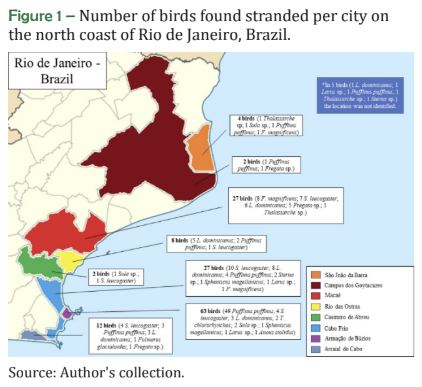
Seabirds are one of the most endangered groups of birds in the world, and identifying aggression factors and injuries is complex and often impractical. The aim of this study was to describe lesions found at necropsy in free‐ living seabirds that were stranded and dead on the beaches of the north coast of the state of Rio de Janeiro, Brazil. During the 17 months of the study, 154 birds were necropsied, with an average of 9 per month. The birds belonged to four orders, and trauma was the most common injury. Injuries to the glenohumeral joint occurred in 16.9% of cases, with a predominance of dislocations. Garbage was found in the stomachs of six birds. Seabirds are constantly exposed to aggressive factors, one of the main ones being human interaction. As a result, the death of free‐living seabirds in the Lagos region is common, frequent, and constant throughout the year, occurring more frequently on the beaches of Armação de Búzios. The main injuries found at necropsy are single or multiple fractures and joint injuries such as dislocation, laceration, and rupture of tendons and ligaments. Cachexia, pulmonary edema, hemorrhage, and ingestion of garbage occur less frequently but also occur continuously. The negative influence of man‐made environmental changes is one of the main causes of death and is a worldwide concern for the preservation of these animals.
Downloads
Publicado
Edição
Seção
Licença
Copyright (c) 2026 Acta Veterinaria Brasilica

Este trabalho está licenciado sob uma licença Creative Commons Attribution 4.0 International License.
Autores que publicam na Acta Veterinaria Brasilica concordam com os seguintes termos: a) Autores mantém os direitos autorais e concedem à revista o direito de primeira publicação, com o trabalho simultaneamente licenciado sob a Licença Creative Commons Attribution que permite o compartilhamento do trabalho com reconhecimento da autoria e publicação inicial nesta revista. b) Autores têm autorização para assumir contratos adicionais separadamente, para distribuição não-exclusiva da versão do trabalho publicada nesta revista (ex.: publicar em repositório institucional ou como capítulo de livro), com reconhecimento de autoria e publicação inicial nesta revista. c) Autores têm permissão e são estimulados a publicar e distribuir seu trabalho online (ex.: em repositórios institucionais ou na sua página pessoal) a qualquer ponto antes ou durante o processo editorial, já que isso pode gerar alterações produtivas, bem como aumentar o impacto e a citação do trabalho publicado (Veja O Efeito do Acesso Livre).

 Esta obra está licenciada com uma Licença