
Effect of neonatal hydrating supplementation on the absorptive surface area of the jejunum in the early stage of Cobb500™
DOI:
https://doi.org/10.21708/avb.2025.19.2.12799Resumo
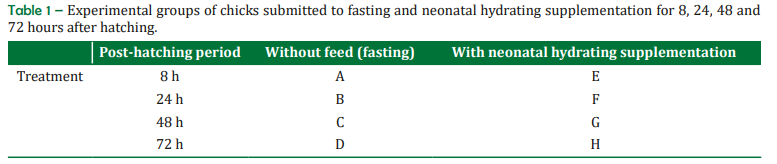
The effect of neonatal supplementation on the absorptive surface area of the jejunum up to 14 days of age was investigated in 320 male Cobb500™ chicks. After vaccination, the neonatal hydrating product was added to the transport box. Four fasted groups (A - D) contained chicks housed at 8, 24, 48, and 72 hours post-hatching and four treated groups (E - H) also contained chicks housed at 8, 24, 48, and 72 hours post-hatching. Samples from four animals per group were collected at 8 h, 24 h, 48 h, and 72 h post-hatching as well as on the 7th and 14th days of production. The following measurements were taken at 10 points along the jejunum of each animal: villus height, mean width, distance between villi, and crypt diameter, followed by the calculation of the absorptive area of the jejunum. Statistical analyses were performed using ANOVA and Tukey's post-hoc test at a 5% significance level (p<0.05). Group E had the largest mean absorptive area throughout the experiment: 853.26 µ² and 1,098 µ² at 24 h and 72 h, respectively. This corresponds to approximately 50% more than that of the control group in the same post-hatching period. The approach described in this study offers a novel option for neonatal poultry nutrition, promoting animal welfare and the commercial viability of newly hatched chicks.
Downloads
Publicado
Edição
Seção
Licença
Copyright (c) 2025 Acta Veterinaria Brasilica

Este trabalho está licenciado sob uma licença Creative Commons Attribution 4.0 International License.
Autores que publicam na Acta Veterinaria Brasilica concordam com os seguintes termos: a) Autores mantém os direitos autorais e concedem à revista o direito de primeira publicação, com o trabalho simultaneamente licenciado sob a Licença Creative Commons Attribution que permite o compartilhamento do trabalho com reconhecimento da autoria e publicação inicial nesta revista. b) Autores têm autorização para assumir contratos adicionais separadamente, para distribuição não-exclusiva da versão do trabalho publicada nesta revista (ex.: publicar em repositório institucional ou como capítulo de livro), com reconhecimento de autoria e publicação inicial nesta revista. c) Autores têm permissão e são estimulados a publicar e distribuir seu trabalho online (ex.: em repositórios institucionais ou na sua página pessoal) a qualquer ponto antes ou durante o processo editorial, já que isso pode gerar alterações produtivas, bem como aumentar o impacto e a citação do trabalho publicado (Veja O Efeito do Acesso Livre).

 Esta obra está licenciada com uma Licença