
Resistance of Nile tilapia leather subjected to pickling with different salt concentrations and exposure times of skins in salt-free water
DOI:
https://doi.org/10.21708/avb.2025.19.2.12832Resumo
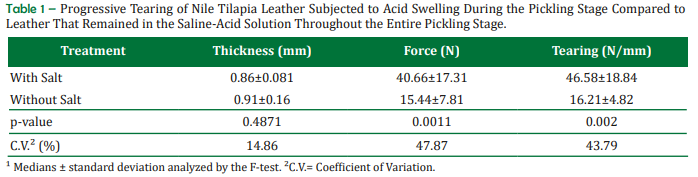
The skins discarded during the filleting process, when subjected to an appropriate tanning process, can be transformed into high-quality leather. Thus, the objective of this study was to analyze the effect of salt concentration and acid swelling as a function of the exposure time of Nile tilapia skins acidified in salt-free water. To this end, three tests were conducted: Test I – Evaluation of pickled skins; Test II – Evaluation of the effect of salt concentration in the pickling stage; and Test III – Evaluation of the effect of pickled skins at different exposure times in salt-free water. The removal of acidified skins to salt-free water promotes acid swelling, which can significantly reduce the leather’s resistance, tear strength, elongation, and tensile strength. A salt concentration below the recommended level leads to acid swelling, while an excessive concentration prevents proper tanning, resulting in collagen fiber densification. Regarding the exposure time of skins in salt-free water, significant losses in their properties were already observed after ten minutes. It is concluded that salt is essential in the pickling stage, requiring a Baumé degree of 7. Skins should not be exposed to a salt-free solution to prevent acid swelling, which compromises their resistance quality. Exposure to salt-free water can reduce elasticity, tensile strength, and progressive tearing, regardless of the exposure duration.
Downloads
Publicado
Edição
Seção
Licença
Copyright (c) 2025 Acta Veterinaria Brasilica

Este trabalho está licenciado sob uma licença Creative Commons Attribution 4.0 International License.
Autores que publicam na Acta Veterinaria Brasilica concordam com os seguintes termos: a) Autores mantém os direitos autorais e concedem à revista o direito de primeira publicação, com o trabalho simultaneamente licenciado sob a Licença Creative Commons Attribution que permite o compartilhamento do trabalho com reconhecimento da autoria e publicação inicial nesta revista. b) Autores têm autorização para assumir contratos adicionais separadamente, para distribuição não-exclusiva da versão do trabalho publicada nesta revista (ex.: publicar em repositório institucional ou como capítulo de livro), com reconhecimento de autoria e publicação inicial nesta revista. c) Autores têm permissão e são estimulados a publicar e distribuir seu trabalho online (ex.: em repositórios institucionais ou na sua página pessoal) a qualquer ponto antes ou durante o processo editorial, já que isso pode gerar alterações produtivas, bem como aumentar o impacto e a citação do trabalho publicado (Veja O Efeito do Acesso Livre).

 Esta obra está licenciada com uma Licença