
Vegetable lipid sources influence the growth of Japanese quails during the rearing phase
DOI:
https://doi.org/10.21708/avb.2025.19.2.12864Resumo
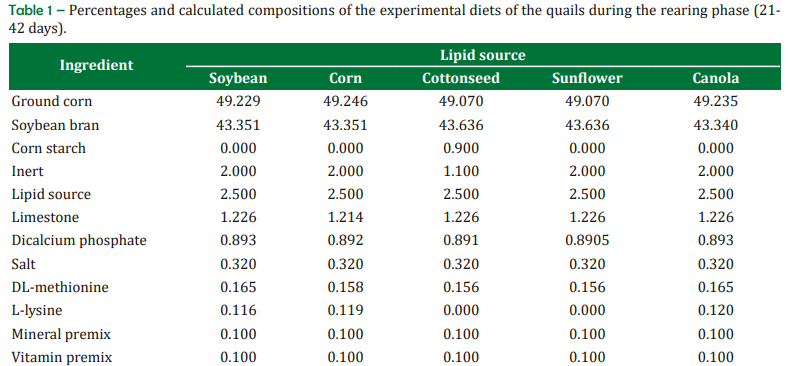
This study evaluated the performance, relative and absolute weights of carcasses and organs, intestinal and reproductive biometry, and allometric coefficients that describe the growth of body parts and organs in Japanese quails (Coturnix japonica) fed different vegetable oil sources during the rearing phase. A total of 400 21-day-old quails were distributed in a completely randomized design with five treatments (soybean, corn, cottonseed, sunflower, and canola oil), each with ten replications of eight birds per treatment, for 21 days (from day 21 to day 42). Soybean, cotton, and sunflower oils positively influence the development of the reproductive tract, maintaining growth rates similar to those of body growth. In contrast, corn and canola oils delayed reproductive organ development. No significant effects were observed on overall performance or organ biometry, with all lipid sources showing similar results in intestinal and organ measurements. Soybean, cotton, and sunflower oils promote reproductive development without negative impacts on overall performance or organ biometry. In contrast, corn and canola oils delayed reproductive development. Therefore, soybean, cotton, and sunflower oils are the most suitable lipid sources for the rearing phase of Japanese quails.
Downloads
Publicado
Edição
Seção
Licença
Copyright (c) 2025 Acta Veterinaria Brasilica

Este trabalho está licenciado sob uma licença Creative Commons Attribution 4.0 International License.
Autores que publicam na Acta Veterinaria Brasilica concordam com os seguintes termos: a) Autores mantém os direitos autorais e concedem à revista o direito de primeira publicação, com o trabalho simultaneamente licenciado sob a Licença Creative Commons Attribution que permite o compartilhamento do trabalho com reconhecimento da autoria e publicação inicial nesta revista. b) Autores têm autorização para assumir contratos adicionais separadamente, para distribuição não-exclusiva da versão do trabalho publicada nesta revista (ex.: publicar em repositório institucional ou como capítulo de livro), com reconhecimento de autoria e publicação inicial nesta revista. c) Autores têm permissão e são estimulados a publicar e distribuir seu trabalho online (ex.: em repositórios institucionais ou na sua página pessoal) a qualquer ponto antes ou durante o processo editorial, já que isso pode gerar alterações produtivas, bem como aumentar o impacto e a citação do trabalho publicado (Veja O Efeito do Acesso Livre).

 Esta obra está licenciada com uma Licença