
Astrocytoma in a french bulldog: 218 days of survival with conservative treatment
DOI:
https://doi.org/10.21708/avb.2025.19.2.13262Resumo
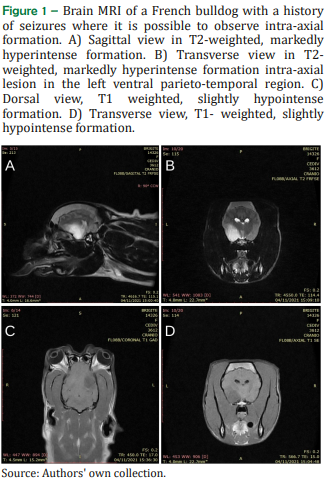
Glioma is the second most common primary intracranial tumor in dogs and is highly prevalent in brachycephalic breeds. This work aims to report a case of astrocytoma, which is a glioma subtype, in a canine with a survival of 218 days with conservative treatment. In this report, a 7-year-old French bulldog was seen with a history of cluster seizures. To control seizures, phenobarbital 50 mg (3.8 mg/kg, PO, BID) was prescribed. Magnetic resonance imaging (MRI) examinations and collection and analysis of cerebrospinal fluid (CSF) were requested. The MRI report showed intra-axial formation, whose main differential diagnosis included a neoplastic process such as glioma. The patient remained clinically well for 218 days, using only phenobarbital. Two hundred and sixteen days after diagnosis, the patient suddenly presented a reduction in consciousness, which progressed to stupor and death within 48 hours. A necropsy and histopathological examination were carried out, which resulted in the neoformation being classified as astrocytoma. Despite the variety of treatments described to treat gliomas, no gold standard treatment protocol has been recognized to optimize the survival of animals in this category of conditions. The patient in this report had a longer survival rate than the average described in the literature. He remained well for 155 days with phenobarbital and another 63 days with the combination of prednisolone. It is concluded, therefore, that the approach and treatment of gliomas are challenging, and that the definition of which treatment provides a better quality of life and longer survival is still uncertain.
Downloads
Publicado
Edição
Seção
Licença
Copyright (c) 2025 Acta Veterinaria Brasilica

Este trabalho está licenciado sob uma licença Creative Commons Attribution 4.0 International License.
Autores que publicam na Acta Veterinaria Brasilica concordam com os seguintes termos: a) Autores mantém os direitos autorais e concedem à revista o direito de primeira publicação, com o trabalho simultaneamente licenciado sob a Licença Creative Commons Attribution que permite o compartilhamento do trabalho com reconhecimento da autoria e publicação inicial nesta revista. b) Autores têm autorização para assumir contratos adicionais separadamente, para distribuição não-exclusiva da versão do trabalho publicada nesta revista (ex.: publicar em repositório institucional ou como capítulo de livro), com reconhecimento de autoria e publicação inicial nesta revista. c) Autores têm permissão e são estimulados a publicar e distribuir seu trabalho online (ex.: em repositórios institucionais ou na sua página pessoal) a qualquer ponto antes ou durante o processo editorial, já que isso pode gerar alterações produtivas, bem como aumentar o impacto e a citação do trabalho publicado (Veja O Efeito do Acesso Livre).

 Esta obra está licenciada com uma Licença