
Prescription of medicinal ozone in small animals’ veterinary practice in southern Brazil
DOI:
https://doi.org/10.21708/avb.2025.19.3.13778Resumo
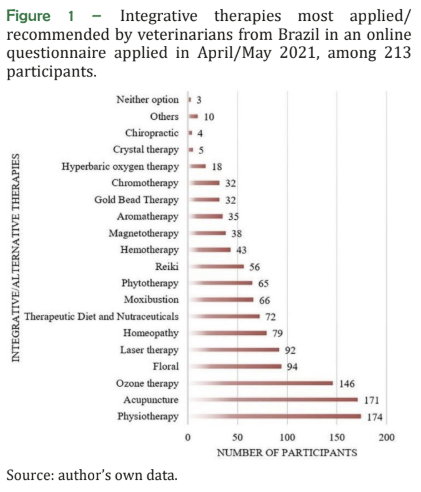
Veterinary medicine is constantly looking for alternatives capable of helping to resolve animal diseases, especially when conventional treatments are ineffective or adverse effects and microbial resistance occur. The objective of this work was to verify the main treatment prescriptions using medicinal ozone in the small animal clinic, as well as the professional profile who prescribe it. Veterinarians from Brazil responded to the electronic questionnaire. Among the 213 survey participants, 98.1% claimed to use at least one integrative therapy in clinical practice. Among these, 72.0% claimed to apply or recommend ozone therapy. Regarding the results of ozone therapy, 90.0% reported good or excellent results. The main diseases treated were healing of open wounds (91.1%), dermatitis (63.7%), asepsis of contaminated wounds (46.6%) and post‐surgical healing (49.7%). Among all participants who use or recommend ozone therapy, 31.5% reported having already indicated therapy in cases of resistance to antibacterials; among these, 73.9% said they had good or excellent results. It was found that female professionals use a greater number of integrative therapies than men. In addition, the older the professionals, and the longer they work, the longer they use ozone therapy. It is concluded that ozone therapy has significant expansion potential and requires scientific evidence for effective and safe clinical application.
Downloads
Publicado
Edição
Seção
Licença
Copyright (c) 2026 Acta Veterinaria Brasilica

Este trabalho está licenciado sob uma licença Creative Commons Attribution 4.0 International License.
Autores que publicam na Acta Veterinaria Brasilica concordam com os seguintes termos: a) Autores mantém os direitos autorais e concedem à revista o direito de primeira publicação, com o trabalho simultaneamente licenciado sob a Licença Creative Commons Attribution que permite o compartilhamento do trabalho com reconhecimento da autoria e publicação inicial nesta revista. b) Autores têm autorização para assumir contratos adicionais separadamente, para distribuição não-exclusiva da versão do trabalho publicada nesta revista (ex.: publicar em repositório institucional ou como capítulo de livro), com reconhecimento de autoria e publicação inicial nesta revista. c) Autores têm permissão e são estimulados a publicar e distribuir seu trabalho online (ex.: em repositórios institucionais ou na sua página pessoal) a qualquer ponto antes ou durante o processo editorial, já que isso pode gerar alterações produtivas, bem como aumentar o impacto e a citação do trabalho publicado (Veja O Efeito do Acesso Livre).

 Esta obra está licenciada com uma Licença