
Pre‐analytical errors that affect laboratory test results and interpretation: validity of an educational technology for veterinarians
DOI:
https://doi.org/10.21708/avb.2025.19.3.13922Resumo
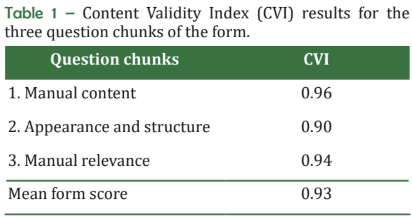
Laboratory tests are conducted in three phases: pre‐analytical, analytical, and post‐analytical. The pre‐ analytical phase has a high incidence of errors that can affect laboratory test results and interpretation. Therefore, continuing education in clinical analysis is crucial to reducing or, ideally, eliminating pre‐analytical errors. This study aimed to validate, with the help of experts, the content (stage 1), appearance (stage 2), and semantics (stage 3) of na educational technology (ET), in the form of a manual, for veterinary clinical pathologists. In stages 1 and 3, a Likert‐type scale was applied to calculate the Content Validity Index (CVI) and Semantic Validity Index (SVI), with a minimum validity threshold of 80%. For stage 2, the Suitability Assessment of Materials (SAM) form was used, with a minimum acceptability score of 40%. Content validity yielded an overall CVI of 90%, while appearance assessment reached 89% acceptability; both was approved in the first assessment round. After incorporating expert recommendations, the manual underwent semantic validity, reaching an SVI of 99% with the target audience. The manual was validated and deemed suitable for use in professional education initiatives in clinical analysis and in routine veterinary practice. The ET was registered with the National Library, and is available on the eduCAPES Repository. The validity process is essential to provide high‐quality educational technologies to promote continuing education, improve veterinary care, enhance laboratory test results, and consequently, animal health.
Downloads
Publicado
Edição
Seção
Licença
Copyright (c) 2026 Acta Veterinaria Brasilica

Este trabalho está licenciado sob uma licença Creative Commons Attribution 4.0 International License.
Autores que publicam na Acta Veterinaria Brasilica concordam com os seguintes termos: a) Autores mantém os direitos autorais e concedem à revista o direito de primeira publicação, com o trabalho simultaneamente licenciado sob a Licença Creative Commons Attribution que permite o compartilhamento do trabalho com reconhecimento da autoria e publicação inicial nesta revista. b) Autores têm autorização para assumir contratos adicionais separadamente, para distribuição não-exclusiva da versão do trabalho publicada nesta revista (ex.: publicar em repositório institucional ou como capítulo de livro), com reconhecimento de autoria e publicação inicial nesta revista. c) Autores têm permissão e são estimulados a publicar e distribuir seu trabalho online (ex.: em repositórios institucionais ou na sua página pessoal) a qualquer ponto antes ou durante o processo editorial, já que isso pode gerar alterações produtivas, bem como aumentar o impacto e a citação do trabalho publicado (Veja O Efeito do Acesso Livre).

 Esta obra está licenciada com uma Licença