Physicochemical and microbiological analyses of clandestine honey commercialized in Rio Branco, Acre
DOI:
https://doi.org/10.21708/avb.2025.19.3.13980Resumo
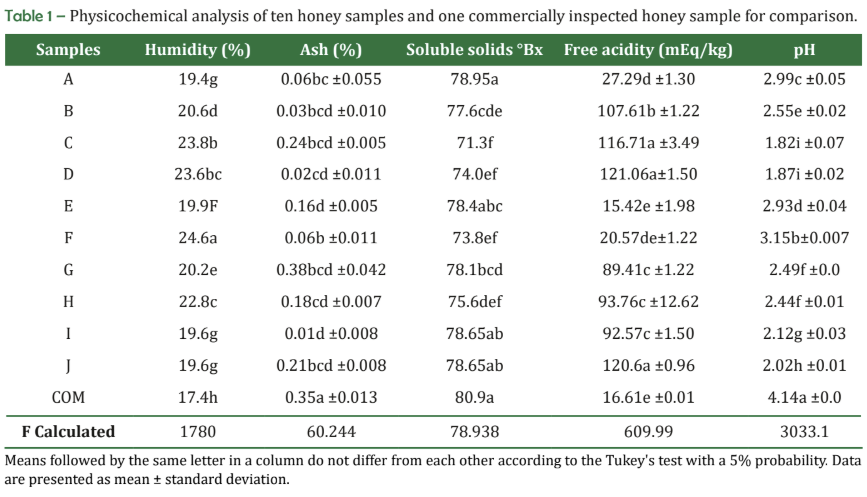
The commercialization of clandestine honey poses risks of adulteration, collection failure, and problems in production, packaging, storage, handling, and transportation, making it unsafe for consumption. The objective of this study was to analyze the physicochemical and microbiological properties of honey marketed in Rio Branco, Acre, Brazil. Ten duplicate samples were collected from street and municipal markets. Labeling standards and physicochemical parameters (moisture, ash and minerals, soluble solids, acidity, and pH) were evaluated using the Fiehe, Lund, and Lugol tests. Microbiological tests included detection of total and thermotolerant coliforms at 35oC and 45oC and mold and yeast counts (CFU/g). Only 50% of the samples had a moisture content within the established limit of 20%. All samples complied with the current standards for ash and mineral contents. The soluble solids had an average value of 76.5°Brix. In contrast, 70% of the samples exceeded the allowed limits of acidity, with an average pH of 2.43. Fiehe, Lund, and Lugol tests detected adulteration in 100% of the samples. Total coliforms were present in 30% of the samples, whereas thermotolerant coliforms were absent. Mold and yeast were observed in 60% of the samples. These honeys do not meet the Brazilian quality standards for stingless bees and, in the absence of standards for stinging bees, pose health risks to consumers.
Downloads
Publicado
Edição
Seção
Licença
Copyright (c) 2026 Acta Veterinaria Brasilica

Este trabalho está licenciado sob uma licença Creative Commons Attribution 4.0 International License.
Autores que publicam na Acta Veterinaria Brasilica concordam com os seguintes termos: a) Autores mantém os direitos autorais e concedem à revista o direito de primeira publicação, com o trabalho simultaneamente licenciado sob a Licença Creative Commons Attribution que permite o compartilhamento do trabalho com reconhecimento da autoria e publicação inicial nesta revista. b) Autores têm autorização para assumir contratos adicionais separadamente, para distribuição não-exclusiva da versão do trabalho publicada nesta revista (ex.: publicar em repositório institucional ou como capítulo de livro), com reconhecimento de autoria e publicação inicial nesta revista. c) Autores têm permissão e são estimulados a publicar e distribuir seu trabalho online (ex.: em repositórios institucionais ou na sua página pessoal) a qualquer ponto antes ou durante o processo editorial, já que isso pode gerar alterações produtivas, bem como aumentar o impacto e a citação do trabalho publicado (Veja O Efeito do Acesso Livre).

 Esta obra está licenciada com uma Licença