Serum biochemical responses to trauma in a rescued savanna hawk (Buteogallus meridionalis): case report
DOI:
https://doi.org/10.21708/avb.2025.19.3.12602Abstract
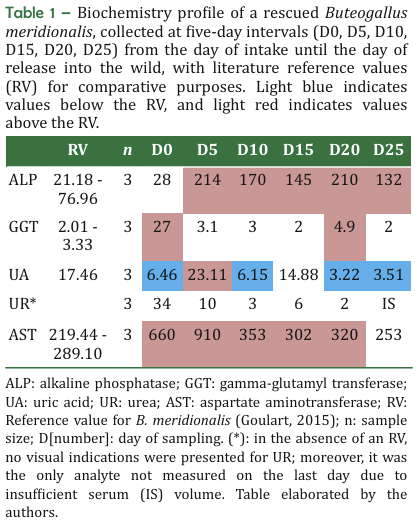
Traumatic accidents in wild birds are a common reason for admission into veterinary care. Serum clinical biochemistry can offer important information for diagnosis, as it surpasses obstacles such as hidden injuries and the birds’ tendency to hide behavioural clinical signs. The objective of this report was to describe the serum biochemical profile of a Buteogallus meridionalis admitted to emergency care after sustaining trauma. Blood samples were collected at 0, 5, 10, 15, 20, and 25 days of treatment and analyzed for alkaline phosphatase, gamma‐glutamyl transferase, aspartate aminotransferase, uric acid, and urea. Results were compared with reference values found in the literature. Marked alterations in serum activity were observed in aspartate aminotransferase, uric acid, alkaline phosphatase, and gamma‐glutamyl transferase levels. While mainly reflecting on potential musculoskeletal involvement and localized hepatobiliary inflammatory responses, this case highlights both the potential and limitations of serum biochemistry as a tool to clinically assess wild birds that suffered trauma from collision, emphasizing the need for further research to clarify the pathological relevance of certain analytes.
Downloads
Published
Issue
Section
License
Copyright (c) 2026 Acta Veterinaria Brasilica

This work is licensed under a Creative Commons Attribution 4.0 International License.
Autores que publicam na Acta Veterinaria Brasilica concordam com os seguintes termos: a) Autores mantém os direitos autorais e concedem à revista o direito de primeira publicação, com o trabalho simultaneamente licenciado sob a Licença Creative Commons Attribution que permite o compartilhamento do trabalho com reconhecimento da autoria e publicação inicial nesta revista. b) Autores têm autorização para assumir contratos adicionais separadamente, para distribuição não-exclusiva da versão do trabalho publicada nesta revista (ex.: publicar em repositório institucional ou como capítulo de livro), com reconhecimento de autoria e publicação inicial nesta revista. c) Autores têm permissão e são estimulados a publicar e distribuir seu trabalho online (ex.: em repositórios institucionais ou na sua página pessoal) a qualquer ponto antes ou durante o processo editorial, já que isso pode gerar alterações produtivas, bem como aumentar o impacto e a citação do trabalho publicado (Veja O Efeito do Acesso Livre).

 Esta obra está licenciada com uma Licença