Fungal contamination in Colossoma macropomum (Cuvier, 1816) from fish farms on Maranhão island
DOI:
https://doi.org/10.21708/avb.2025.19.3.12800Abstract
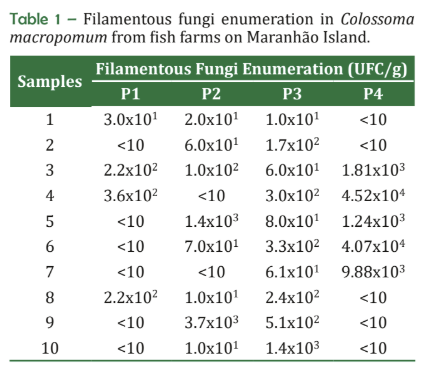
The objective was to verify the occurrence of fungal contamination in Colossoma macropomum from crops in the Maranhão Island. For this, 40 specimens of C. macropomum (tambaquis) were evaluated, between males and females, in the fattening phase, from four fish farms. In a laboratory environment, muscle fragments were removed followed by the enumeration and identification of filamentous fungi (macroscopic morphology, colonial characteristics and microscopic morphology). In the enumeration, filamentous fungi were found in 67.5% (n= 27/40) of the specimens evaluated, with fungal populations ranging from 1.0 x 101 to 4.52 x 10⁴ CFU/gram. Through microscopic morphology, associated with the macroscopic one, the genera Aspergillus sp., Penicillium sp., Paecylomeces sp. and Rhizopus sp. With the identification keys used, two species of Aspergillus were identified, A. niger and A. terreus. The last species with mycotoxigenic potential. Based on the results obtained, it was concluded that the specimens of C. macropomum analyzed showed high fungal contamination, with the identification of two potentially mycotoxigenic genera. Fish, as they constitute a nutritionally rich type of fish, endowed with intrinsic characteristics that favor their deterioration, added to the conditions in the sampled fish farms favorable to the survival and multiplication of fungi, require more effective control and inspection, which permeate the storage of the rations offered in the creations. All these precautions are aimed at eliminating the possibility of the occurrence of toxin-producing fungi, which can compromise the quality of this product of animal origin, impacting production and with inherent risks to the health of consumers.
Dowloads
Pubblicato
Fascicolo
Sezione
Licenza
Copyright (c) 2026 Acta Veterinaria Brasilica

Questo volume è pubblicato con la licenza Creative Commons Attribuzione 4.0 Internazionale.
Autores que publicam na Acta Veterinaria Brasilica concordam com os seguintes termos: a) Autores mantém os direitos autorais e concedem à revista o direito de primeira publicação, com o trabalho simultaneamente licenciado sob a Licença Creative Commons Attribution que permite o compartilhamento do trabalho com reconhecimento da autoria e publicação inicial nesta revista. b) Autores têm autorização para assumir contratos adicionais separadamente, para distribuição não-exclusiva da versão do trabalho publicada nesta revista (ex.: publicar em repositório institucional ou como capítulo de livro), com reconhecimento de autoria e publicação inicial nesta revista. c) Autores têm permissão e são estimulados a publicar e distribuir seu trabalho online (ex.: em repositórios institucionais ou na sua página pessoal) a qualquer ponto antes ou durante o processo editorial, já que isso pode gerar alterações produtivas, bem como aumentar o impacto e a citação do trabalho publicado (Veja O Efeito do Acesso Livre).

 Esta obra está licenciada com uma Licença