Congenital transmission of Mycoplasma agalactiae following a contagious agalactia outbreak in a goat herd from Pernambuco, Brazil
DOI:
https://doi.org/10.21708/avb.2025.19.3.12915Abstract
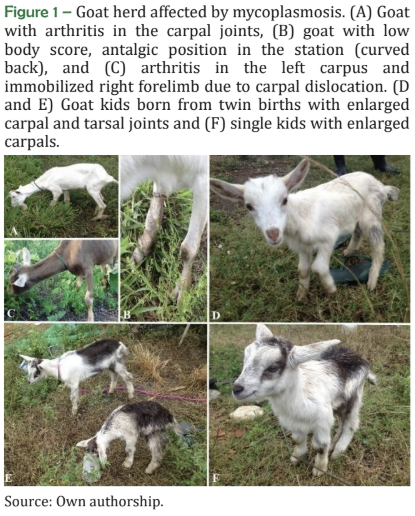
Contagious agalactia, caused by Mycoplasma agalactiae, is an endemic disease in dairy goats in Northeastern Brazil, with significant health and economic implications. This case report describes a congenital transmission of M. agalactiae in newborns from a dairy goat herd affected by a clinical outbreak in Feira Nova, Pernambuco. Following the introduction of a symptomatic buck, rapid dissemination of the disease was observed, characterized by decreased milk production, mastitis, arthritis, and conjunctivitis. Three newborn kids, born to symptomatic does, exhibited polyarthritis at birth without any clinical or pathological evidence of umbilical infection or postnatal exposure. Molecular testing (PCR) confirmed the presence of M. agalactiae in synovial fluid. Necropsies revealed joint degeneration with accumulation of orange serofibrinous fluid and fibrin deposition in the coxofemoral, atlanto‐occipital, carpal, and tarsal joints. Serological tests for small ruminant lentiviruses were negative. These findings support the hypothesis of early intrauterine infection and highlight the role of vertical transmission as a complementary route in the epidemiology of caprine mycoplasmosis. The report underscores the importance of early laboratory diagnosis and strict sanitary control, particularly regarding introducing animals into herds and monitoring pregnant goats.
Dowloads
Pubblicato
Fascicolo
Sezione
Licenza
Copyright (c) 2026 Acta Veterinaria Brasilica

Questo volume è pubblicato con la licenza Creative Commons Attribuzione 4.0 Internazionale.
Autores que publicam na Acta Veterinaria Brasilica concordam com os seguintes termos: a) Autores mantém os direitos autorais e concedem à revista o direito de primeira publicação, com o trabalho simultaneamente licenciado sob a Licença Creative Commons Attribution que permite o compartilhamento do trabalho com reconhecimento da autoria e publicação inicial nesta revista. b) Autores têm autorização para assumir contratos adicionais separadamente, para distribuição não-exclusiva da versão do trabalho publicada nesta revista (ex.: publicar em repositório institucional ou como capítulo de livro), com reconhecimento de autoria e publicação inicial nesta revista. c) Autores têm permissão e são estimulados a publicar e distribuir seu trabalho online (ex.: em repositórios institucionais ou na sua página pessoal) a qualquer ponto antes ou durante o processo editorial, já que isso pode gerar alterações produtivas, bem como aumentar o impacto e a citação do trabalho publicado (Veja O Efeito do Acesso Livre).

 Esta obra está licenciada com uma Licença