
Identification of agents potentially causing dermatological problems in sloths Bradypus variegatus (Schinz, 1825) from brazilian northeastern states
DOI:
https://doi.org/10.21708/avb.2025.19.2.12780Resumo
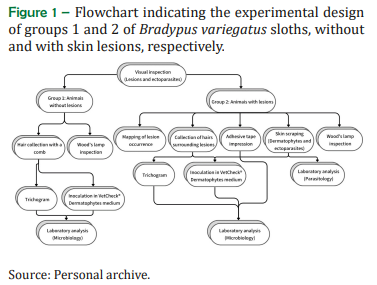
This study identified ectoparasites and dermatophyte fungi in the fur of sloths of the Bradypus variegatus species from different states in the Brazilian Northeast. For this purpose, the animals were divided into two groups: group 1 without lesions and group 2 with lesions. In the presence of macroscopic ectoparasites, specimens were removed and classified. A Wood’s lamp was directed toward the furs of the sloths. Trichograms were performed, in which hairs were chosen randomly from the animals in group 1; while, in group 2, the hairs were extracted from the periphery of the lesion. In sloths with lesions, impressions were also made using adhesive tape, and the injured areas were scraped to prepare slides to identify dermatophyte fungi and microscopic ectoparasites. Part of the hair obtained in both groups was inoculated into VetCheck culture medium, and in case of fungal growth, a subculture was performed followed by a microculture. Based on the data obtained, the macroscopic ectoparasite Amblyomma sp. was observed in an uninjured pup. In an adult female, in one of her lesions, the microscopic ectoparasite Lobalges trouessarti was found. The Wood’s lamp demonstrated fluorescence in all animals in group 2 and a large part of group 1, with the presence of the dermatophyte Nannizzia gypsea, confirmed through microscopic analysis of the macroconidia.
Downloads
Publicado
Edição
Seção
Licença
Direitos autorais (c) 2025 Acta Veterinaria Brasilica

Este trabalho está licenciado sob uma licença Creative Commons Attribution 4.0 International License.
Autores que publicam na Acta Veterinaria Brasilica concordam com os seguintes termos: a) Autores mantém os direitos autorais e concedem à revista o direito de primeira publicação, com o trabalho simultaneamente licenciado sob a Licença Creative Commons Attribution que permite o compartilhamento do trabalho com reconhecimento da autoria e publicação inicial nesta revista. b) Autores têm autorização para assumir contratos adicionais separadamente, para distribuição não-exclusiva da versão do trabalho publicada nesta revista (ex.: publicar em repositório institucional ou como capítulo de livro), com reconhecimento de autoria e publicação inicial nesta revista. c) Autores têm permissão e são estimulados a publicar e distribuir seu trabalho online (ex.: em repositórios institucionais ou na sua página pessoal) a qualquer ponto antes ou durante o processo editorial, já que isso pode gerar alterações produtivas, bem como aumentar o impacto e a citação do trabalho publicado (Veja O Efeito do Acesso Livre).

 Esta obra está licenciada com uma Licença