Frequency of duplicity and anatomical characterization of double renal arteries in dogs (Canis lupus familiaris, Linnaeus, 1758)
DOI:
https://doi.org/10.21708/avb.2025.19.2.12792Resumo
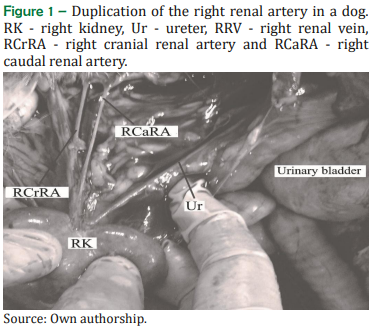
The aim of this study was to evaluate the frequency of duplicity of the renal arteries in dogs and to morphologically describe double renal arteries. A total of 100 mongrel dogs, of both sexes and varied age and size, were used. Nineteen animals presented duplicity of the renal artery. In 78.95% of the cases, the left renal artery was double, in 15.79% the right renal artery was double, and in 5.26% both were double. The length of the cranial renal arteries ranged from 30 to 71 mm, and that of the caudal arteries from 31 to 74 mm. In 57.9% of the dogs, the cranial renal arteries were thicker than the caudal; in 21.05%, the caudal was thicker; and in 21.05%, both had the same diameter. The distance between the aortic hiatus and the first renal artery varied from 48 to 132 mm. The distance between the cranial mesenteric artery and the cranial renal artery ranged from 15 to 41 mm, and between the second renal artery and the testicular/ovarian arteries from 15 to 62 mm. Duplication of the renal artery was observed in 19% of dogs, with unilateral left duplicity being the most frequent. The lengths of the double renal arteries and their distances in relation to neighboring vessels were variable among the animals, and in most of them, the cranial renal artery was thicker than the caudal artery.
Downloads
Publicado
Edição
Seção
Licença
Direitos autorais (c) 2025 Acta Veterinaria Brasilica

Este trabalho está licenciado sob uma licença Creative Commons Attribution 4.0 International License.
Autores que publicam na Acta Veterinaria Brasilica concordam com os seguintes termos: a) Autores mantém os direitos autorais e concedem à revista o direito de primeira publicação, com o trabalho simultaneamente licenciado sob a Licença Creative Commons Attribution que permite o compartilhamento do trabalho com reconhecimento da autoria e publicação inicial nesta revista. b) Autores têm autorização para assumir contratos adicionais separadamente, para distribuição não-exclusiva da versão do trabalho publicada nesta revista (ex.: publicar em repositório institucional ou como capítulo de livro), com reconhecimento de autoria e publicação inicial nesta revista. c) Autores têm permissão e são estimulados a publicar e distribuir seu trabalho online (ex.: em repositórios institucionais ou na sua página pessoal) a qualquer ponto antes ou durante o processo editorial, já que isso pode gerar alterações produtivas, bem como aumentar o impacto e a citação do trabalho publicado (Veja O Efeito do Acesso Livre).

 Esta obra está licenciada com uma Licença