Factors impacting diagnostic conclusions: a 30-year retrospective analysis in the Pathology Department of the Federal Rural University of Rio de Janeiro
DOI:
https://doi.org/10.21708/avb.2025.19.2.12848Resumo
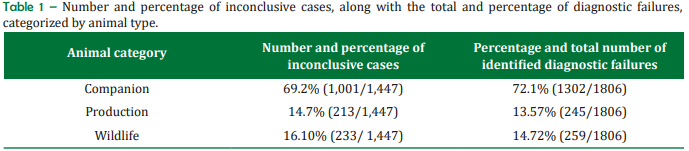
Based on necropsy and histopathology records from the Pathology Department of the Federal Rural University of Rio de Janeiro spanning the years 1990 to 2020, this study analyzed the factors influencing diagnostic conclusions. Cases with unclear or inconclusive results were compiled and categorized according to the pre-analytical (prior to necropsy), analytical (during necropsy), and post-analytical (histopathological analysis and ancillary testing following necropsy) phases. The data were categorized into production animals, companion animals, and wildlife, and subsequently subjected to statistical analysis. Over the study period, a total of 37,057 examinations were conducted, of which 3.9% resulted in inconclusive diagnoses. Among these inconclusive cases, 26.4% were attributed to failures in the pre-analytical phase, 34.8% in the analytical phase, and 38.8% in the post-analytical phase. Pre-analytical failures were identified in 37.17% of companion animal cases, 21.22% of production animal cases, and 18.15% of wildlife cases. In the post-analytical phase, failures were identified in 24.73% of companion animal cases, 59.18% of production animal cases, and 66.02% of wildlife cases. The findings indicate that companion animals had the highest prevalence of inconclusive diagnoses, primarily due to the higher volume of cases in this category at SAP. This was followed by wildlife animals, which frequently arrive at the facility in advanced stages of autolysis for necropsy. The lowest prevalence of inconclusive diagnoses was observed in production animals, owing to the smaller number of such cases and the limited availability of complementary diagnostic tests.
Downloads
Publicado
Edição
Seção
Licença
Copyright (c) 2025 Acta Veterinaria Brasilica

Este trabalho está licenciado sob uma licença Creative Commons Attribution 4.0 International License.
Autores que publicam na Acta Veterinaria Brasilica concordam com os seguintes termos: a) Autores mantém os direitos autorais e concedem à revista o direito de primeira publicação, com o trabalho simultaneamente licenciado sob a Licença Creative Commons Attribution que permite o compartilhamento do trabalho com reconhecimento da autoria e publicação inicial nesta revista. b) Autores têm autorização para assumir contratos adicionais separadamente, para distribuição não-exclusiva da versão do trabalho publicada nesta revista (ex.: publicar em repositório institucional ou como capítulo de livro), com reconhecimento de autoria e publicação inicial nesta revista. c) Autores têm permissão e são estimulados a publicar e distribuir seu trabalho online (ex.: em repositórios institucionais ou na sua página pessoal) a qualquer ponto antes ou durante o processo editorial, já que isso pode gerar alterações produtivas, bem como aumentar o impacto e a citação do trabalho publicado (Veja O Efeito do Acesso Livre).

 Esta obra está licenciada com uma Licença