Natural intoxication by Euphorbia milii (“crown of Christ”) in a dog in Rio de Janeiro: a case report
DOI:
https://doi.org/10.21708/avb.2025.19.3.12976Resumo
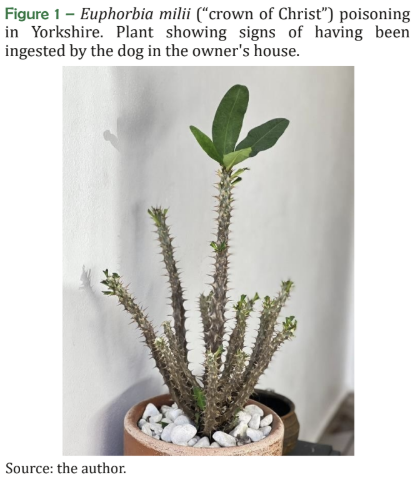
Ornamental plants are not part of a dog’s diet, and even those not usually consumed, such as Euphorbia milii, can be accidentally ingested, which can be dangerous when inducing mild to severe poisoning and even death. Pets ingest these plants because of stress, discomfort, and pain. This study aimed to describe the clinical, epidemiological, and pathological aspects of intoxication by E. milii, an ornamental plant known as the “crown of Christ” in a domestic dog and warn owners about possible accidents with ornamental plants. A 9‐year‐old Yorkshire bitch was taken to a veterinary clinic after ingesting large quantities of the plant. The animal presented with hematemesis, hematochezia, hyperthermia, mydriasis, motor incoordination, mental confusion, and agitation and died during treatment for poisoning. At necropsy, cyanosis, congestion of the mucous membranes, petechiae, and suffusions were observed in various organs, particularly in areas perforated by the plant’s thorns. The stomach was very dilated and full of still‐green leaves, as well as thorns. Histopathology showed a congestive and hemorrhagic state in various organs, erythrocyte aggregation, vacuolization, and necrosis of renal tubular cells.
Downloads
Publicado
Edição
Seção
Licença
Copyright (c) 2026 Acta Veterinaria Brasilica

Este trabalho está licenciado sob uma licença Creative Commons Attribution 4.0 International License.
Autores que publicam na Acta Veterinaria Brasilica concordam com os seguintes termos: a) Autores mantém os direitos autorais e concedem à revista o direito de primeira publicação, com o trabalho simultaneamente licenciado sob a Licença Creative Commons Attribution que permite o compartilhamento do trabalho com reconhecimento da autoria e publicação inicial nesta revista. b) Autores têm autorização para assumir contratos adicionais separadamente, para distribuição não-exclusiva da versão do trabalho publicada nesta revista (ex.: publicar em repositório institucional ou como capítulo de livro), com reconhecimento de autoria e publicação inicial nesta revista. c) Autores têm permissão e são estimulados a publicar e distribuir seu trabalho online (ex.: em repositórios institucionais ou na sua página pessoal) a qualquer ponto antes ou durante o processo editorial, já que isso pode gerar alterações produtivas, bem como aumentar o impacto e a citação do trabalho publicado (Veja O Efeito do Acesso Livre).

 Esta obra está licenciada com uma Licença