Efficacy of laser therapy in feline sporotrichosis lesion resistant to conventional treatment ‐ case report
DOI:
https://doi.org/10.21708/avb.2025.19.3.12907Resumo
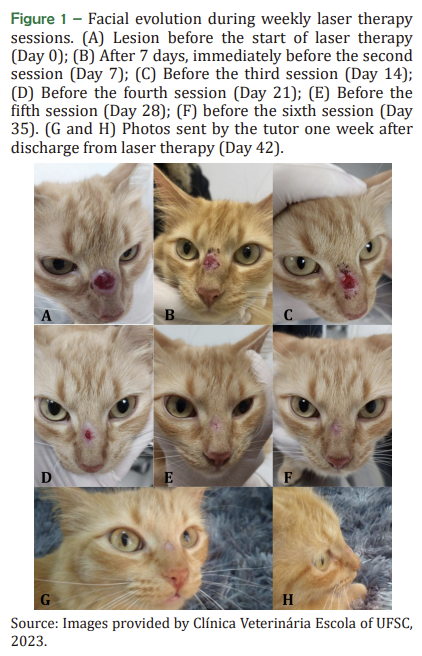
Sporotrichosis, an expanding zoonosis in Brazil, is caused by the yeast fungus Sporothrix spp., with cats serving as the primary carriers of the disease due to their habits that can contribute to the pathogen's spread. The disease can manifest subclinically or as local and multifocal skin lesions, with multiple lesions involving mucous membranes being more frequent. Treatment is often prolonged, challenging, and requires special care. The objective was to report the case of a 1‐year‐old female cat diagnosed with sporotrichosis refractory to conventional treatment. The patient was referred for integrative treatment with laser therapy after five months of treatment with itraconazole associated with potassium iodide with successive dose increases and without satisfactory therapeutic response. Six sessions of laser therapy were performed with weekly application of 1J continuous red for 10 seconds in four points of the wound edges and a central point for remission of the lesion, maintaining the drug treatment for another month after the end of the sessions. The patient had no relapses during the subsequent three months of follow‐up. Thus, laser therapy has proven to be an effective and promising therapeutic approach for treating sporotrichosis in felines, especially in cases that do not respond adequately to conventional treatment. The combination of different therapeutic modalities can improve the clinical outcomes and quality of life of affected animals, highlighting the importance of integrated approaches in managing this zoonosis.
Downloads
Publicado
Edição
Seção
Licença
Copyright (c) 2026 Acta Veterinaria Brasilica

Este trabalho está licenciado sob uma licença Creative Commons Attribution 4.0 International License.
Autores que publicam na Acta Veterinaria Brasilica concordam com os seguintes termos: a) Autores mantém os direitos autorais e concedem à revista o direito de primeira publicação, com o trabalho simultaneamente licenciado sob a Licença Creative Commons Attribution que permite o compartilhamento do trabalho com reconhecimento da autoria e publicação inicial nesta revista. b) Autores têm autorização para assumir contratos adicionais separadamente, para distribuição não-exclusiva da versão do trabalho publicada nesta revista (ex.: publicar em repositório institucional ou como capítulo de livro), com reconhecimento de autoria e publicação inicial nesta revista. c) Autores têm permissão e são estimulados a publicar e distribuir seu trabalho online (ex.: em repositórios institucionais ou na sua página pessoal) a qualquer ponto antes ou durante o processo editorial, já que isso pode gerar alterações produtivas, bem como aumentar o impacto e a citação do trabalho publicado (Veja O Efeito do Acesso Livre).

 Esta obra está licenciada com uma Licença