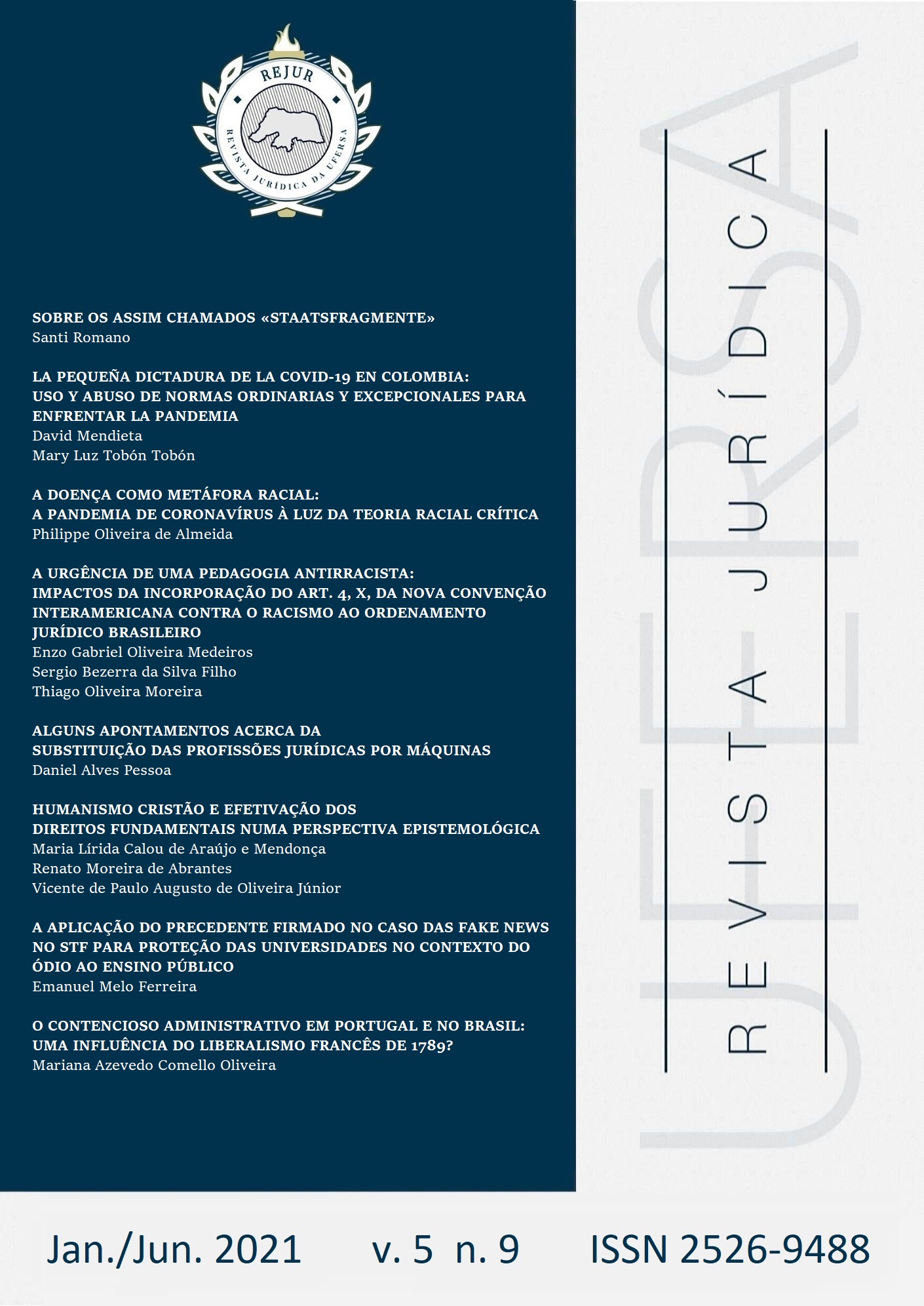
CHRISTIAN HUMANISM AND EFFECTIVENESS OF FUNDAMENTAL RIGHTS IN AN EPISTEMOLOGICAL PERSPECTIVE
DOI:
https://doi.org/10.21708/issn2526-9488.v5.n9.p88-110.2021Abstract
The present work aims to analyze the humanist proposal to overcome conflicts between fundamental rights, based on the concept of the human person. To this end, the research, of a qualitative nature and motivated by the International Symposium “Diritti Fondamentali e conflitti fra diritti”, promoted in Rome, by the Fondazione Ratzinger, between 15 and 16 November 2018, was carried out through analysis documentary, based on the doctrine about the human person, the principle of human dignity and Christian humanism. Initially, the concept of the human person is analyzed under the philosophical and theological prisms. The principle of human dignity is dealt with in the sequence, identifying Christian foundations, outlining the post-positivist proposal of the law and the historical framework of the process of positivizing that principle. The theology of the theologian Joseph Ratzinger (Pope Emeritus Benedict XVI) is brought up about the “dictatorship of relativism” from which the human person must be preserved. Finally, we explain about Christian humanism, as a concrete proposal to overcome barbarism and found a new society, in which charity and common justice prevail and in which conflicts of fundamental rights are minimized. It is concluded that, despite the variety of rights, legal science, whose core and purpose is the human person, must have mechanisms capable of curbing threats to fundamental rights, especially those linked to the principle of human dignity, and to reconcile the intellectual and ideological strands and positions that, although different from each other, seek, each in their own way, the same objective: the protection and realization of individual rights.
Published
Issue
Section
License
Ao enviarem seus artigos, os autores concordam com os seguintes termos: 1. Cede-se à REJUR, gratuitamente e sem regime de exclusividade, seus direitos autorais; 2. Confere-se à REJUR os direitos de primeira publicação, permitindo-se o livre compartilhamento dos artigos veiculados em formato PDF; 3. Divulgações posteriores em periódicos, livros, obras coletivas ou eventos de qualquer natureza devem fazer referência à REJUR como meio de publicação original; 4. Os autores são responsáveis pelo conteúdo constante de seus textos; 5. O trabalho será licenciado também sob a Licença Creative Commons Attribution 4.0 International License (CC-BY).