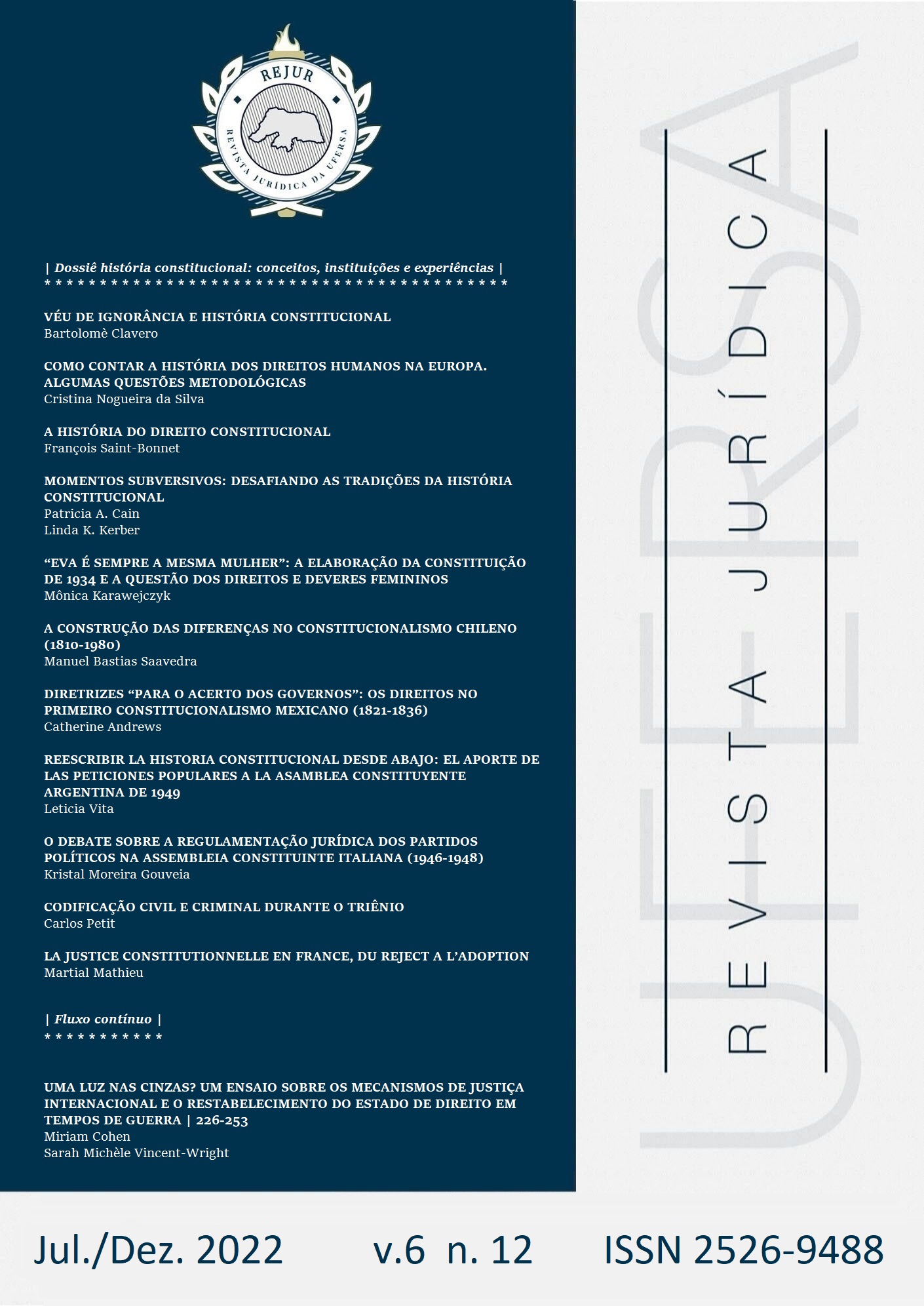
CONSTITUTIONAL JUSTICE IN FRANCE, FROM REJECTION TO ADHERENCE
DOI:
https://doi.org/10.21708/issn2526-9488.v6.n12.p204-216.2022Abstract
For a long time, French constitutional history used to be dominated by a tradition of hostility to judicial activism. As a matter of fact, the French Revolution consecrated a definition of law which put judges in a situation of subordination to legislation. The Revolution thus condemned the claim of higher judicial courts who had tried to compel the royal legislation to abide by constitutional principles. From the Enlightenment to the Second Empire, attempts to impose the superiority of constitutional norms failed because of parliamentary sovereignty, which reached its zenith under the Third Republic. During the second half of the twentieth century, this tradition of parliamentary sovereignty progressively eroded, under the influence of constitutional justice’s expansion in Western European countries. Though, after the Second World War, the supporters of constitutionality review didn’t consider that such a task should be entrusted to a judicial body. Hostility to judicial activism hence led to the establishment of constitutionality review without constitutional justice. The progressive emergence of constitutional justice under the Fifth Republic ensued from a break with the spirit of the Constitution of 1958. Initiated by the Conseil constitutionnel, this change was later confirmed by constitutional amendments, which consecrated the laborious adherence to constitutional justice by the French institutions.
Downloads
Published
Issue
Section
License
Copyright (c) 2023 UFERSA's Law Review

This work is licensed under a Creative Commons Attribution-NonCommercial-NoDerivatives 4.0 International License.
Ao enviarem seus artigos, os autores concordam com os seguintes termos: 1. Cede-se à REJUR, gratuitamente e sem regime de exclusividade, seus direitos autorais; 2. Confere-se à REJUR os direitos de primeira publicação, permitindo-se o livre compartilhamento dos artigos veiculados em formato PDF; 3. Divulgações posteriores em periódicos, livros, obras coletivas ou eventos de qualquer natureza devem fazer referência à REJUR como meio de publicação original; 4. Os autores são responsáveis pelo conteúdo constante de seus textos; 5. O trabalho será licenciado também sob a Licença Creative Commons Attribution 4.0 International License (CC-BY).