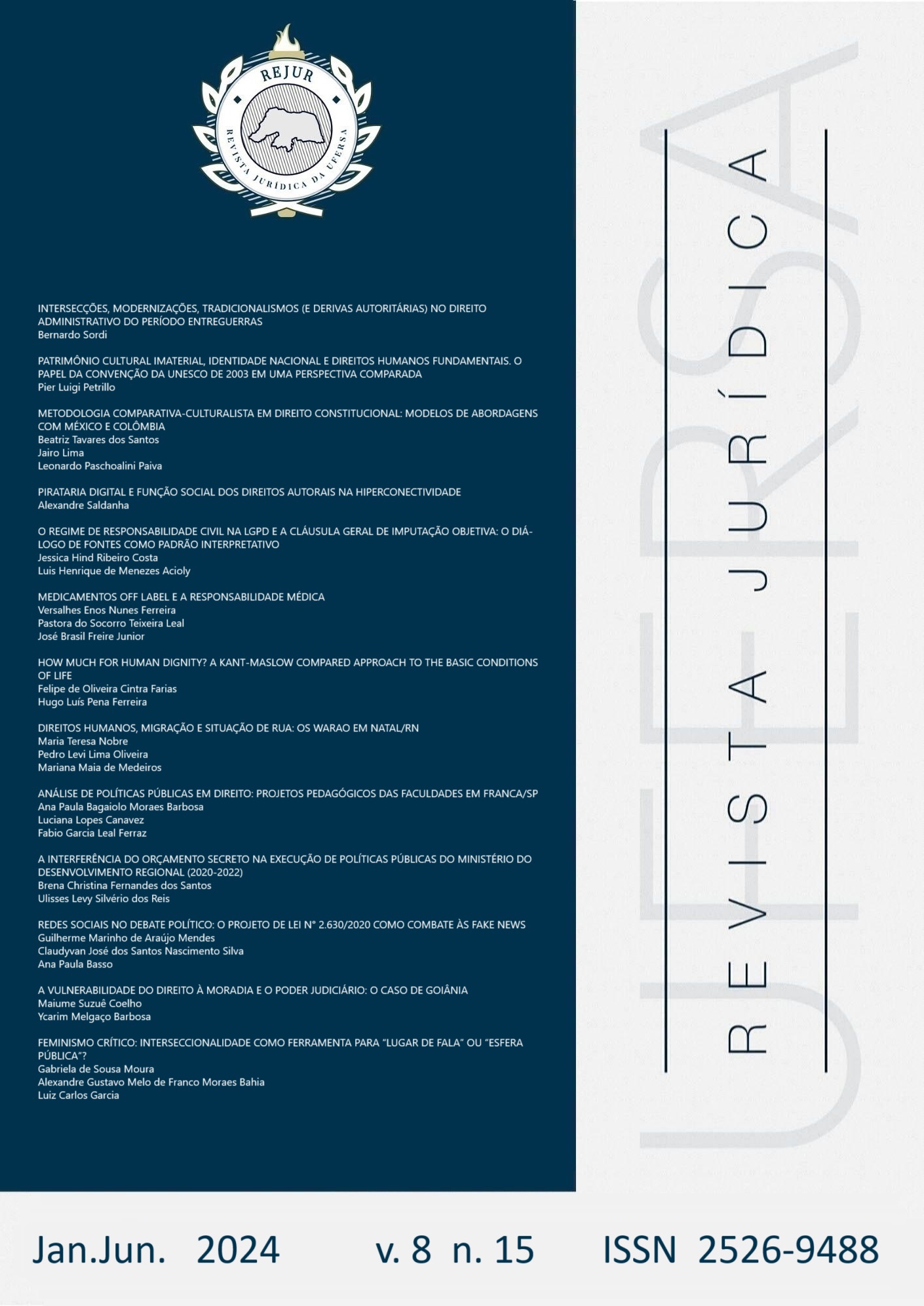
Critical feminism: intersectionality as a tool for the "place of speech" or the "Public Sphere"?
DOI:
https://doi.org/10.21708/issn2526-9488.v8.n15.p259-285.2024Abstract
Thinking about oppression is always an arduous task, especially when such an analysis takes place in spatializations where each individual can be crossed by several social factors that alone already have the power to generate situations of subalternization and social subjection. Highlighting social actors from the condition of legitimacy to speak emerges as a problem to be analyzed in depth. Thus, the problematization based on the tool of intersectionality as a lens capable of shedding light on thrombi of social marginalization, and bringing to the text the concepts of “place of speech”, which has been straying from debates in general regarding its condition as an element of Discourse Analysis and the “public sphere” as spaces that include everyone as possible participants as discourse agents, can provide directions for socially emancipatory processes. A theoretically sustainable understanding of elements such as “intersectionality”, “place of speech” and “public sphere”, cannot be limited to a formal conceptual analysis, but demands the assimilation of the expansion of its pragmatic effects also so that concrete struggles have effectiveness in the democratic context. This is the background of the reflection in which the work operates and proposes itself as a contribution to a critical feminism.
Published
Issue
Section
License
Copyright (c) 2024 UFERSA's Law Review

This work is licensed under a Creative Commons Attribution-NonCommercial-NoDerivatives 4.0 International License.
Ao enviarem seus artigos, os autores concordam com os seguintes termos: 1. Cede-se à REJUR, gratuitamente e sem regime de exclusividade, seus direitos autorais; 2. Confere-se à REJUR os direitos de primeira publicação, permitindo-se o livre compartilhamento dos artigos veiculados em formato PDF; 3. Divulgações posteriores em periódicos, livros, obras coletivas ou eventos de qualquer natureza devem fazer referência à REJUR como meio de publicação original; 4. Os autores são responsáveis pelo conteúdo constante de seus textos; 5. O trabalho será licenciado também sob a Licença Creative Commons Attribution 4.0 International License (CC-BY).