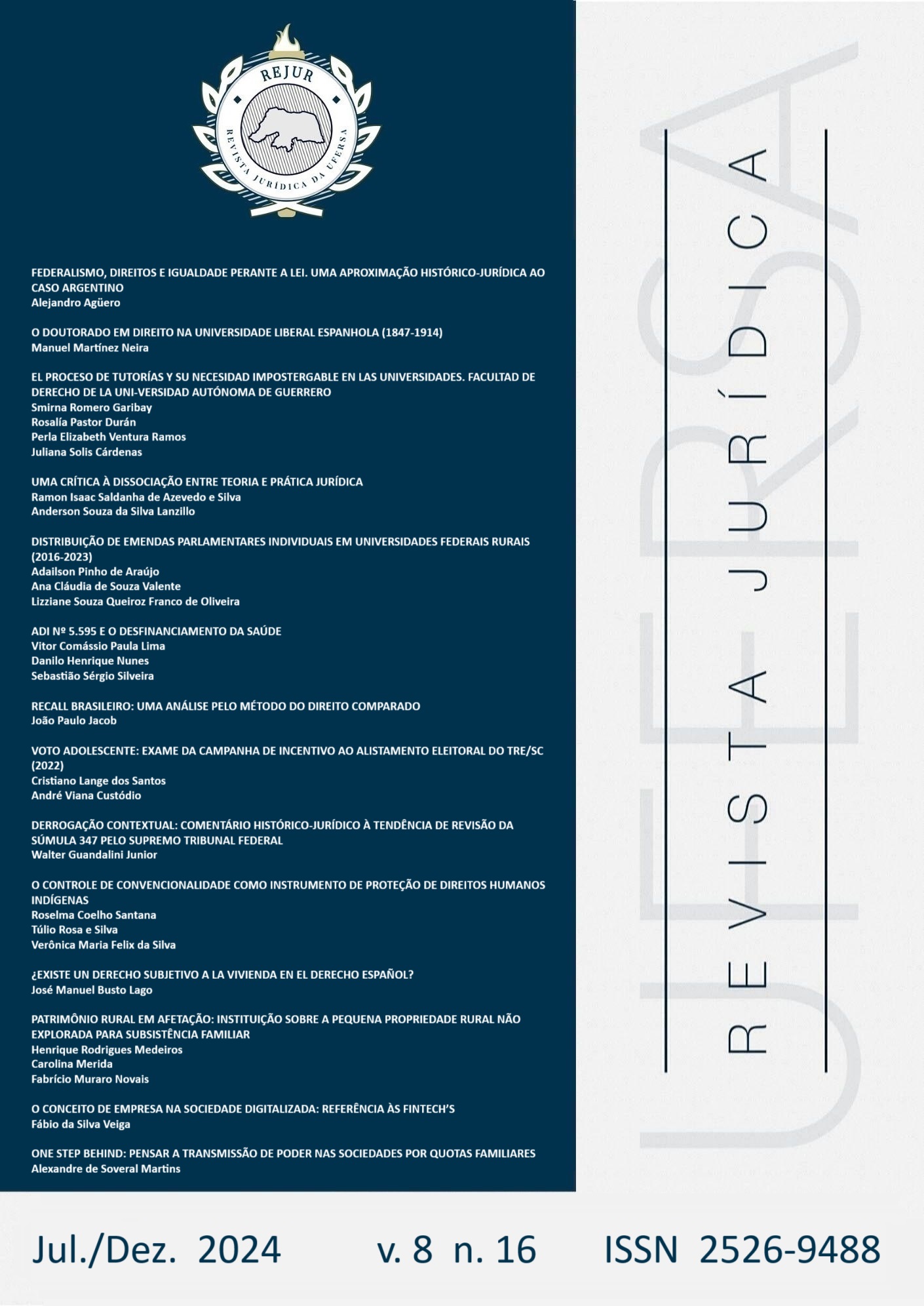
Recall brasileiro: uma análise pelo método do Direito Comparado
DOI:
https://doi.org/10.21708/issn2526-9488.v8.n16.p131-147.2024Abstract
This article investigates the feasibility of implementing the recall mechanism in Brazil, using the comparative law method. By analyzing legal systems that already adopt recall, such as the United States and Latin American countries, it aims to understand the implications, advantages, and challenges of its application in the Brazilian context. The main objective of this article is to assess the feasibility of implementing the recall mechanism in the Brazilian political system. Specifically, it seeks to: Analyze international experiences of recall and their outcomes; Identify the legal and political challenges for the implementation of recall in Brazil; Evaluate the potential consequences of adopting recall for political stability and governance in Brazil. The research adopts the comparative law method, through which legislation, processes, and recall cases in different jurisdictions are analyzed. The selection of countries for comparison is based on the diversity of political systems and the consolidated presence of recall in their democratic structure. Results indicate that recall could strengthen democracy in Brazil but faces obstacles such as constitutional reforms, partisan use, and the risk of political instability. Its effectiveness depends on integration into the political culture.
Published
Issue
Section
License
Copyright (c) 2024 UFERSA's Law Review

This work is licensed under a Creative Commons Attribution-NonCommercial-NoDerivatives 4.0 International License.
Ao enviarem seus artigos, os autores concordam com os seguintes termos: 1. Cede-se à REJUR, gratuitamente e sem regime de exclusividade, seus direitos autorais; 2. Confere-se à REJUR os direitos de primeira publicação, permitindo-se o livre compartilhamento dos artigos veiculados em formato PDF; 3. Divulgações posteriores em periódicos, livros, obras coletivas ou eventos de qualquer natureza devem fazer referência à REJUR como meio de publicação original; 4. Os autores são responsáveis pelo conteúdo constante de seus textos; 5. O trabalho será licenciado também sob a Licença Creative Commons Attribution 4.0 International License (CC-BY).