Social Management in Prison
Substantive Rationality Among Content
DOI:
https://doi.org/10.21708/issn2526-9488.v9.n18.p138-156.2025Abstract
Our objective is to typify elements of substantive rationality in organizations composed of inmates of the Brazilian prison system. It is based on the theoretical contributions of Guerreiro Ramos, who discusses substantive rationality in organizations, and complemented by the works of Serva. During a two-year university extension course held at the Association for the Protection and Assistance of Convicts (APAC) in the city of Macau/RN, we interacted with people deprived of their liberty and collected spontaneous speeches, life stories and testimonies in a field diary. We evidence the presence of elements of substantive rationality such as self-realization, understanding, ethical judgment, authenticity, emancipatory values and autonomy, distributed in non-hierarchical, dialogical management practices, related to work in the prison of a cooperative (informal) and the Council of Sincerity and Solidarity (CSS), both composed exclusively of people deprived of liberty. Autonomy and self-management emerge in the context, even within coercive limits. We thus expose a useful case for the debate around possibilities and innovation in public security; we highlighted the protagonism of inmates in the resocialization process, in the management of solidarity work organizations and internal social control and; we reveal, although permeated with contradictions and impasses, possibilities for theoretical advancement in the field of social management linked to the penal system.
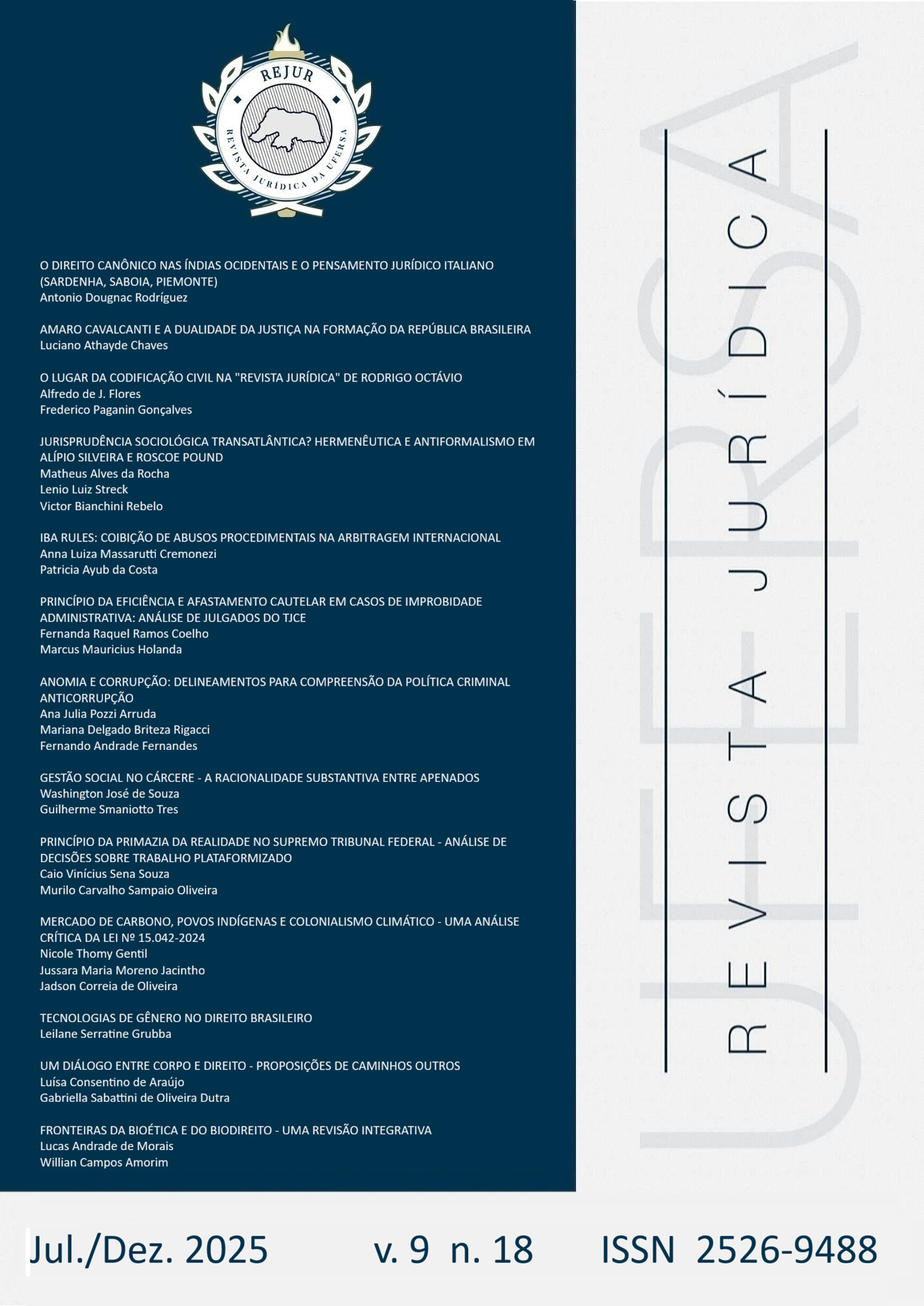
Downloads
Published
Issue
Section
License
Copyright (c) 2025 UFERSA's Law Review

This work is licensed under a Creative Commons Attribution-NonCommercial-NoDerivatives 4.0 International License.
Ao enviarem seus artigos, os autores concordam com os seguintes termos: 1. Cede-se à REJUR, gratuitamente e sem regime de exclusividade, seus direitos autorais; 2. Confere-se à REJUR os direitos de primeira publicação, permitindo-se o livre compartilhamento dos artigos veiculados em formato PDF; 3. Divulgações posteriores em periódicos, livros, obras coletivas ou eventos de qualquer natureza devem fazer referência à REJUR como meio de publicação original; 4. Os autores são responsáveis pelo conteúdo constante de seus textos; 5. O trabalho será licenciado também sob a Licença Creative Commons Attribution 4.0 International License (CC-BY).