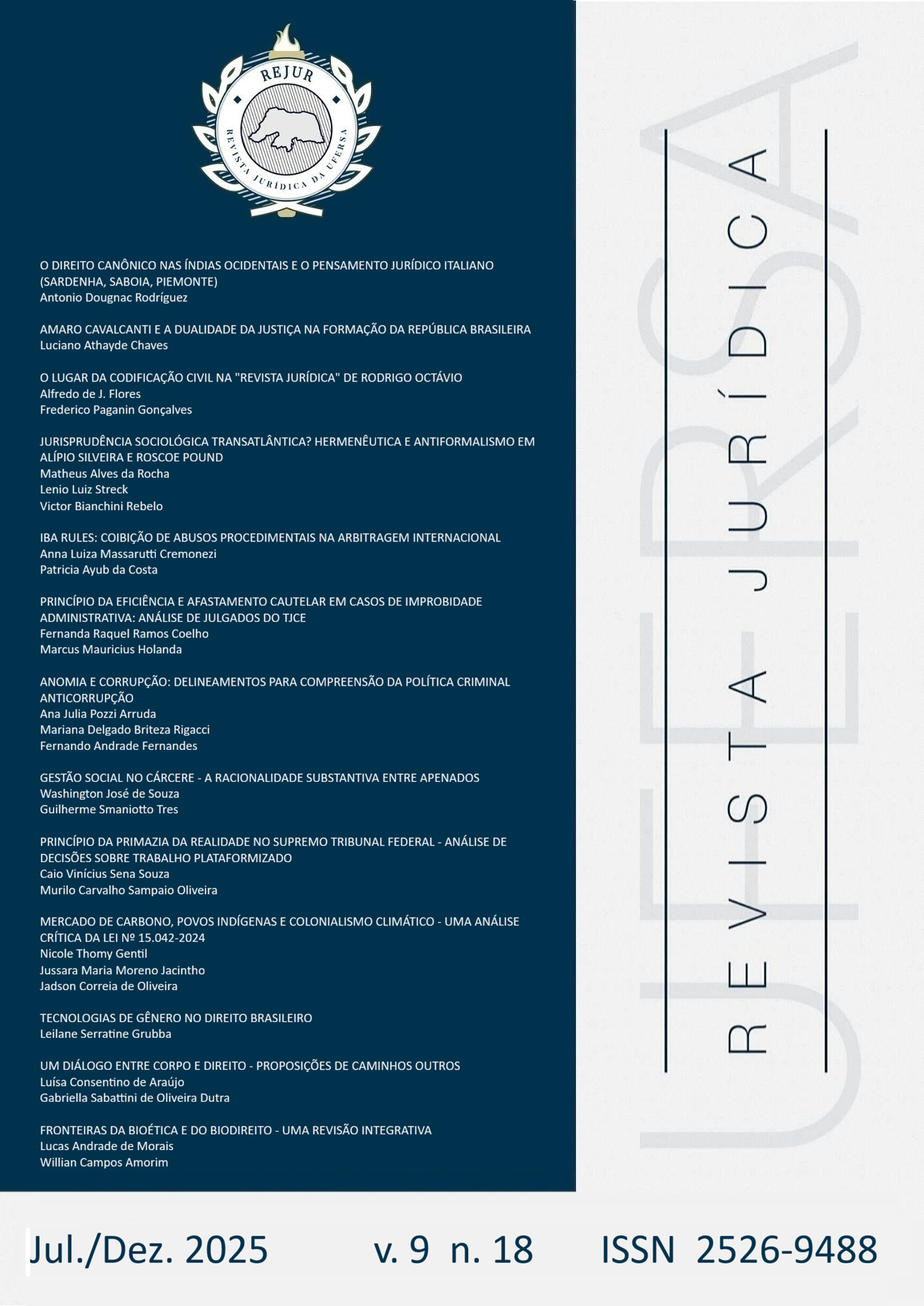
Carbon market, native communities and climate colonialism
a critical analysis of the Law nº 15.042/2024
DOI:
https://doi.org/10.21708/issn2526-9488.v9.n18.p175-196.2025Abstract
The article seeks to critically analyze the provisions regarding indigenous peoples in Law No. 15,042/2024, guided by climate colonialism, in order to define whether the carbon market, in the Brazilian mold, perpetuates forms of colonialist domination. To this end, the inductive methodology was used, of a qualitative, bibliographic and documentary nature, through the use of concepts worked by Quijano and Dussel regarding coloniality, as well as definitions of Olúfẹ́mi Táíwò and Gifford for the analysis of the colonialist strand related to climate change. In addition, the main international agreements for the construction and structuring of the carbon market were presented, namely, the Kyoto Protocol, the Paris Agreement, and the Conferences between the Parties 27 and 29. In addition, the position of indigenous communities on the carbon market was extracted both from developments of the Decolonial School, as well as from documents produced by indigenous tribes, especially the Belém Charter, the Munduruku Protocol and the Xapuri Declaration. The results indicate that the carbon market is in line with the worldview shared by traditional communities; and that legal provisions are not efficient as a mechanism for protecting indigenous peoples. It is concluded that Law No. 15,042/2024 is an instrument for the continuity of colonial forms of domination, specifically climate colonialism.
Downloads
Published
Issue
Section
License
Copyright (c) 2025 UFERSA's Law Review

This work is licensed under a Creative Commons Attribution-NonCommercial-NoDerivatives 4.0 International License.
Ao enviarem seus artigos, os autores concordam com os seguintes termos: 1. Cede-se à REJUR, gratuitamente e sem regime de exclusividade, seus direitos autorais; 2. Confere-se à REJUR os direitos de primeira publicação, permitindo-se o livre compartilhamento dos artigos veiculados em formato PDF; 3. Divulgações posteriores em periódicos, livros, obras coletivas ou eventos de qualquer natureza devem fazer referência à REJUR como meio de publicação original; 4. Os autores são responsáveis pelo conteúdo constante de seus textos; 5. O trabalho será licenciado também sob a Licença Creative Commons Attribution 4.0 International License (CC-BY).