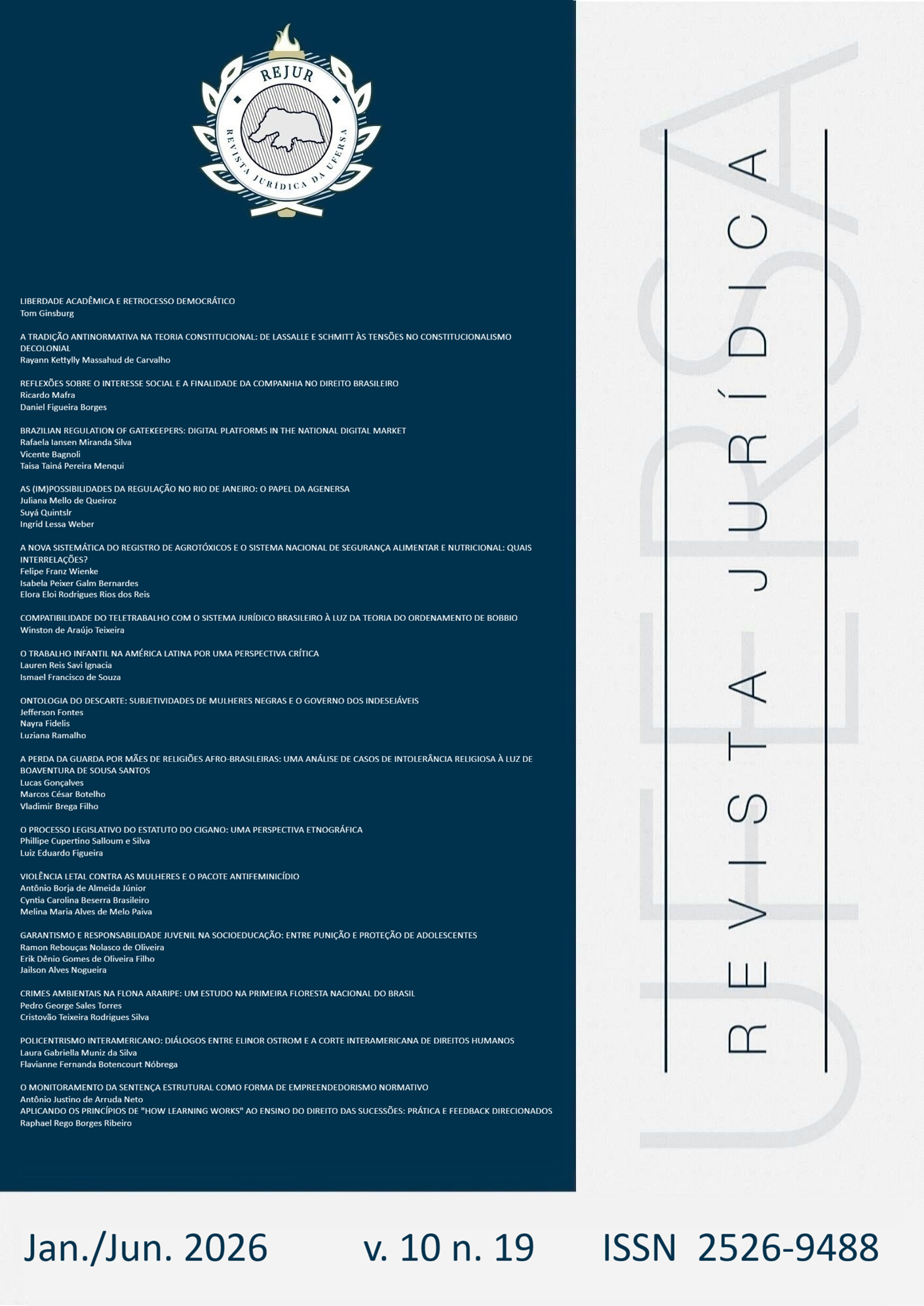
Liberdade acadêmica e retrocesso democrático
DOI:
https://doi.org/10.21708/issn2526-9488.v10.n19.p1-28.2026Abstract
Around the world – and increasingly within established democracies – academic freedom is being narrowed by polarization, populist rhetoric, and legal engineering. This article argues that universities function as core epistemic institutions in constitutional democracies and are therefore early and frequent targets of would-be autocrats. It offers three contributions. First, it systematizes the repertoire of backsliding strategies – societal intimidation and “autocratic legalism” (e.g., purges, criminal defamation, selective funding, politicized appointments, curricular mandates) – and traces their chilling effects on scholars and students. Second, using comparative constitutional text and doctrine, it maps protections for individual academic speech, institutional autonomy, and the state’s affirmative duties, contrasting the United States’ judge-made, First Amendment-adjacent protections with the explicit guarantees common in many constitutions. Third, it synthesizes emerging international and regional jurisprudence (UN treaty bodies; the ECtHR on academic and extramural speech; the EU Charter’s Article 13 and Commission v. Hungary on CEU; Inter-American principles and cases; African Commission decisions) to show how transnational norms can constrain or at least stigmatize domestic erosions. The article concludes that safeguarding universities requires robust constitutional entrenchment of both individual and institutional freedoms plus positive state obligations to maintain an enabling environment for knowledge production. Absent such measures, democratic backsliding will continue to exploit ambiguity in law to subordinate universities to partisan projects and degrade the democratic public sphere.
Downloads
Published
Issue
Section
License
Copyright (c) 2026 UFERSA's Law Review

This work is licensed under a Creative Commons Attribution 4.0 International License.
Ao enviarem seus artigos, os autores concordam com os seguintes termos: 1. Cede-se à REJUR, gratuitamente e sem regime de exclusividade, seus direitos autorais; 2. Confere-se à REJUR os direitos de primeira publicação, permitindo-se o livre compartilhamento dos artigos veiculados em formato PDF; 3. Divulgações posteriores em periódicos, livros, obras coletivas ou eventos de qualquer natureza devem fazer referência à REJUR como meio de publicação original; 4. Os autores são responsáveis pelo conteúdo constante de seus textos; 5. O trabalho será licenciado também sob a Licença Creative Commons Attribution 4.0 International License (CC-BY).