
Antimicrobial resistance and mecA gene in Staphylococcus spp. isolates from horses used in family farming
DOI:
https://doi.org/10.21708/avb.2022.16.4.10974Resumo
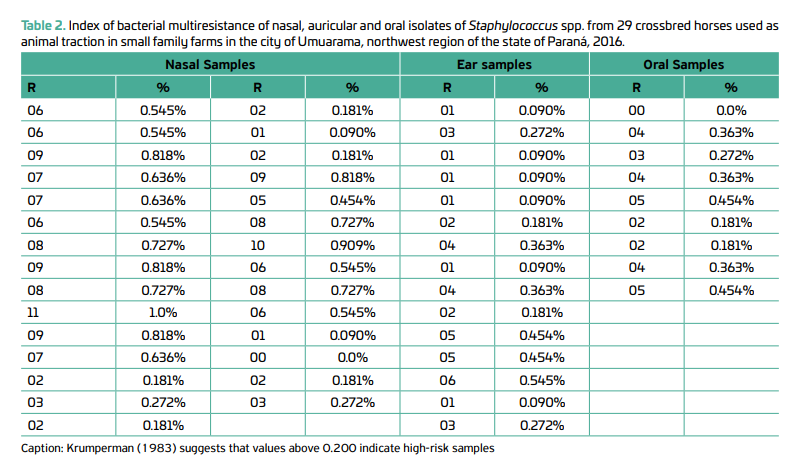
Horses can contribute to the spread of bacterial diseases, which can be caused mainly by, Staphylococcus spp., which are part of the animals' commensal microbiota, but it is also considered a pathogenic microorganism capable of causing serious infections. vancomycin, when it is resistant to methicillin. Antimicrobial resistance is considered a major health problem by the World Health Organization and the emergence of the mecA gene, responsible for resistance to the class of beta-lactam antibiotics. Thus, the aim of this work was to investigate the antimicrobial resistance profile and the presence of the mecA gene in Staphylococcus spp. isolated from the nasal, oral and auricular microbiota of horses used as animal traction on small family farms. Nasal, oral and auricular swabs were collected from 38 horses, with 29 (76.3%) isolated in nasal swab, 15 (39.4%) in auricular swab and 9 (23.6%) in oral swab, totaling 53 Staphylococcus spp. and 50 (94.33%) samples were resistant to the 11 antimicrobials tested, none of which were positive for molecular tests to identify the mecA gene. The results demonstrate the presence of Staphylococcus spp. associated with high (94.33%) bacterial resistance, indicating that horses can be considered reservoirs of multi-resistant microorganisms.
Downloads
Publicado
Edição
Seção
Licença
Copyright (c) 2022 Acta Veterinaria Brasilica

Este trabalho está licenciado sob uma licença Creative Commons Attribution 4.0 International License.
Autores que publicam na Acta Veterinaria Brasilica concordam com os seguintes termos: a) Autores mantém os direitos autorais e concedem à revista o direito de primeira publicação, com o trabalho simultaneamente licenciado sob a Licença Creative Commons Attribution que permite o compartilhamento do trabalho com reconhecimento da autoria e publicação inicial nesta revista. b) Autores têm autorização para assumir contratos adicionais separadamente, para distribuição não-exclusiva da versão do trabalho publicada nesta revista (ex.: publicar em repositório institucional ou como capítulo de livro), com reconhecimento de autoria e publicação inicial nesta revista. c) Autores têm permissão e são estimulados a publicar e distribuir seu trabalho online (ex.: em repositórios institucionais ou na sua página pessoal) a qualquer ponto antes ou durante o processo editorial, já que isso pode gerar alterações produtivas, bem como aumentar o impacto e a citação do trabalho publicado (Veja O Efeito do Acesso Livre).

 Esta obra está licenciada com uma Licença