
Arterial vascularization of the base of the brain of Bradypus variegatus (Schinz, 1825)
DOI:
https://doi.org/10.21708/avb.2025.19.3.12417Abstract
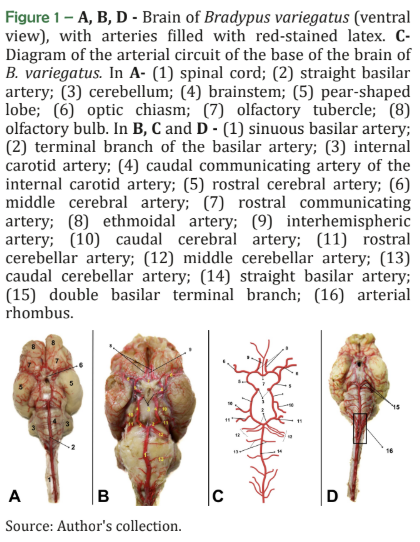
The blood supply to the brain has unique and highly relevant characteristics, which are associated with the sensitivity, specialty and importance of the nervous tissue. Among these characteristics, the presence of an arterial circuit located at the base of the brain stands out. This circuit has modifications in relation to the different groups of vertebrates. According to the morphological model, it can be classified into three types (type I, type II, and type III) and according to the phylogenetic model, it can be classified into three stages (initial, intermediate, and final). When analyzing a sample group of 11 adult animals of the species Bradypus variegatus, it was found that the irrigation of the brain of this mammal is supplied by the carotid system, rostrally, and vertebrobasilar system, caudally. It is classified as type II, according to the morphological classification, and intermediate, in relation to the phylogenetic development model.
Downloads
Published
Issue
Section
License
Copyright (c) 2026 Acta Veterinaria Brasilica

This work is licensed under a Creative Commons Attribution 4.0 International License.
Autores que publicam na Acta Veterinaria Brasilica concordam com os seguintes termos: a) Autores mantém os direitos autorais e concedem à revista o direito de primeira publicação, com o trabalho simultaneamente licenciado sob a Licença Creative Commons Attribution que permite o compartilhamento do trabalho com reconhecimento da autoria e publicação inicial nesta revista. b) Autores têm autorização para assumir contratos adicionais separadamente, para distribuição não-exclusiva da versão do trabalho publicada nesta revista (ex.: publicar em repositório institucional ou como capítulo de livro), com reconhecimento de autoria e publicação inicial nesta revista. c) Autores têm permissão e são estimulados a publicar e distribuir seu trabalho online (ex.: em repositórios institucionais ou na sua página pessoal) a qualquer ponto antes ou durante o processo editorial, já que isso pode gerar alterações produtivas, bem como aumentar o impacto e a citação do trabalho publicado (Veja O Efeito do Acesso Livre).

 Esta obra está licenciada com uma Licença