Vulvar sebaceous adenocarcinoma in cattle – case report
DOI:
https://doi.org/10.21708/avb.2025.19.3.12811Resumo
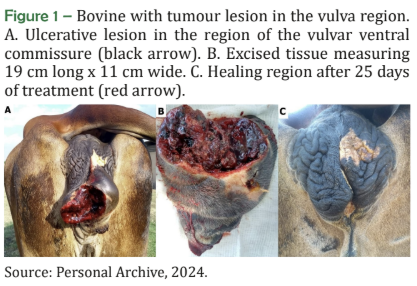
In bovine clinical practice, published data on neoplasms remain infrequent in the Brazilian literature. Describing the particularities of each pathology is essential, as it provides a foundation for comparing the different types of tumours that occur in cattle. Thus, the objective of this study was to report a clinical case of sebaceous carcinoma in a bovine, representing the first documented case involving the vulvar region in cattle in Brazil. A three‐and‐a‐half‐year‐old female Gir crossbred cow presented with an extensive lesion on the ventral portion of the vulva. The lesion was ulcerated, reddish, firm in consistency, hyperaemic, and exhibited a serosanguineous discharge. Following initial management, a treatment protocol consisting of ceftiofur and flunixin meglumine was instituted, aiming to reduce inflammation and improve the characteristics of the lesion. After completion of the initial treatment, the lesion was surgically excised with a minimum margin of 5 cm around its entire perimeter. Complete healing of the surgical wound was observed 25 days post‐operation. Histopathological analysis of the excised tissue revealed features consistent with sebaceous adenocarcinoma. Sebaceous tumours represent a rare group of skin neoplasms, whose classification encompasses a spectrum of lesions ranging from benign to malignant, as well as other neoplasms exhibiting sebaceous differentiation.
Downloads
Publicado
Edição
Seção
Licença
Copyright (c) 2026 Acta Veterinaria Brasilica

Este trabalho está licenciado sob uma licença Creative Commons Attribution 4.0 International License.
Autores que publicam na Acta Veterinaria Brasilica concordam com os seguintes termos: a) Autores mantém os direitos autorais e concedem à revista o direito de primeira publicação, com o trabalho simultaneamente licenciado sob a Licença Creative Commons Attribution que permite o compartilhamento do trabalho com reconhecimento da autoria e publicação inicial nesta revista. b) Autores têm autorização para assumir contratos adicionais separadamente, para distribuição não-exclusiva da versão do trabalho publicada nesta revista (ex.: publicar em repositório institucional ou como capítulo de livro), com reconhecimento de autoria e publicação inicial nesta revista. c) Autores têm permissão e são estimulados a publicar e distribuir seu trabalho online (ex.: em repositórios institucionais ou na sua página pessoal) a qualquer ponto antes ou durante o processo editorial, já que isso pode gerar alterações produtivas, bem como aumentar o impacto e a citação do trabalho publicado (Veja O Efeito do Acesso Livre).

 Esta obra está licenciada com uma Licença