Would L-carnitine improve the survival and viability of vitrified/warmed in vitro bovine blastocysts?
DOI:
https://doi.org/10.21708/avb.2025.19.2.12880Resumo
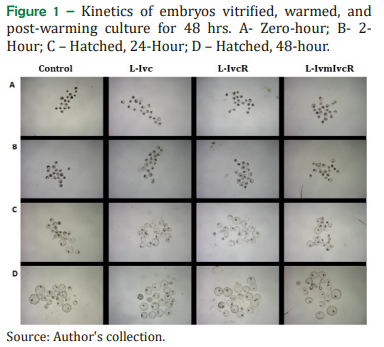
The experiment was conducted to verify the effects of delipidation using L-carnitine on the development and survival of in vitro-produced bovine embryos, cryopreserved by vitrification, using the evaluation of the intracytoplasmic content of lipids, cellular apoptosis, mitochondrial potential, the rates of re-expansion and hatching post-warming. The embryos were cultured without the addition of L-carnitine (Control), in the presence of L-carnitine (0.6 mg/mL) added to the culture medium of D1 to D7 (L-Ivc), during the culture before vitrification and post-warming re-culture (L-IvcR) and during in vitro maturation, in vitro culture before vitrification and post-warming re-culture (L-IvmIvcR). The supplementation with L-carnitine did not change the cleavage rate in D3 (p ˃0.05) but increased the production of blastocysts in D7 by 20.7% and the proportion of grade I embryos by 30.1% in LIvc (p<0.05), as well as the re-expansion rate (2-hour) (p<0.05), but the hatching rates and the number of degenerate structures at the 24 and 48-hour post-warming did not differ between treatments (p˃0.05). The treatment with L-carnitine was effective in reducing cell apoptosis, intracytoplasmic content of lipids, and mitochondrial potential of blastocysts (p<0.001). In conclusion, media supplementation with 0.6 mg/mL of L-carnitine during in vitro embryo production improved vitrified/warmed bovine blastocysts' survival and viability, reducing cell apoptosis and intracellular lipids' amount and positively impacting mitochondrial activity potential. Under the presented conditions, this supplementation can be used only in the culture medium since no additional benefit was verified by adding this L-carnitine concentration during oocyte maturation, blastocyst culture, or post-warming culture.
Downloads
Publicado
Edição
Seção
Licença
Copyright (c) 2025 Acta Veterinaria Brasilica

Este trabalho está licenciado sob uma licença Creative Commons Attribution 4.0 International License.
Autores que publicam na Acta Veterinaria Brasilica concordam com os seguintes termos: a) Autores mantém os direitos autorais e concedem à revista o direito de primeira publicação, com o trabalho simultaneamente licenciado sob a Licença Creative Commons Attribution que permite o compartilhamento do trabalho com reconhecimento da autoria e publicação inicial nesta revista. b) Autores têm autorização para assumir contratos adicionais separadamente, para distribuição não-exclusiva da versão do trabalho publicada nesta revista (ex.: publicar em repositório institucional ou como capítulo de livro), com reconhecimento de autoria e publicação inicial nesta revista. c) Autores têm permissão e são estimulados a publicar e distribuir seu trabalho online (ex.: em repositórios institucionais ou na sua página pessoal) a qualquer ponto antes ou durante o processo editorial, já que isso pode gerar alterações produtivas, bem como aumentar o impacto e a citação do trabalho publicado (Veja O Efeito do Acesso Livre).

 Esta obra está licenciada com uma Licença