Frontiers of Bioethics and Biolaw
An Integrative Review
DOI:
https://doi.org/10.21708/issn2526-9488.v9.n18.p239-266.2025Abstract
Technological advancements in the fields of biotechnology and medicine bring new ethical and legal challenges, such as genetic manipulation, cloning, and artificial intelligence in medicine, requiring appropriate ethical reflection and legal regulation to protect human dignity and fundamental rights. In this context, the present article aims to identify the relationship between bioethics and biolaw in the scientific literature found in bioethics journals classified by Qualis Capes (Brazil), exploring how these fields complement and interact with each other. The methodology used is an integrative review, allowing the analysis of studies with different designs. Articles published between 2019 and 2023 in bioethics journals classified by Qualis Capes were analyzed. Fourteen articles were selected that address topics such as ectogenesis, end-of-life issues in children, sports doping, neuroimaging in criminal proceedings, biotechnological patents, genetic privacy, and therapeutic abortion. It was observed that the studies indicate that bioethics provides essential moral principles, while biolaw transforms these principles into concrete legal norms. Interdisciplinary collaboration between these fields is seen as necessary to address ethical and legal dilemmas, ensuring that biomedical practices respect human dignity and fundamental rights. It is concluded that the intersection between bioethics and biolaw is essential to keep pace with scientific advances, promoting ethical and legal regulations that protect human rights and promote dignity in the context of biotechnological innovations.
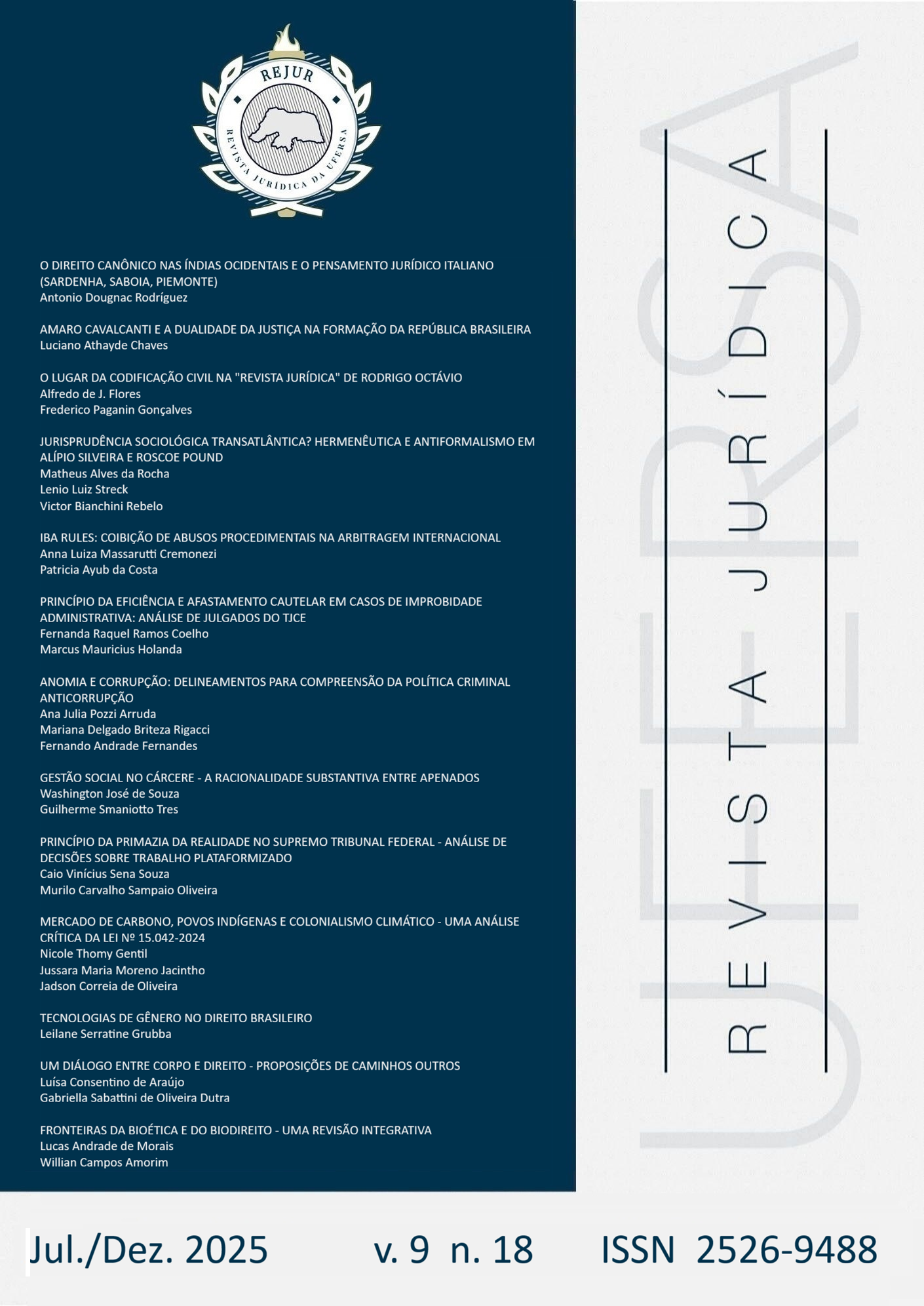
Downloads
Published
Issue
Section
License
Copyright (c) 2025 UFERSA's Law Review

This work is licensed under a Creative Commons Attribution-NonCommercial-NoDerivatives 4.0 International License.
Ao enviarem seus artigos, os autores concordam com os seguintes termos: 1. Cede-se à REJUR, gratuitamente e sem regime de exclusividade, seus direitos autorais; 2. Confere-se à REJUR os direitos de primeira publicação, permitindo-se o livre compartilhamento dos artigos veiculados em formato PDF; 3. Divulgações posteriores em periódicos, livros, obras coletivas ou eventos de qualquer natureza devem fazer referência à REJUR como meio de publicação original; 4. Os autores são responsáveis pelo conteúdo constante de seus textos; 5. O trabalho será licenciado também sob a Licença Creative Commons Attribution 4.0 International License (CC-BY).