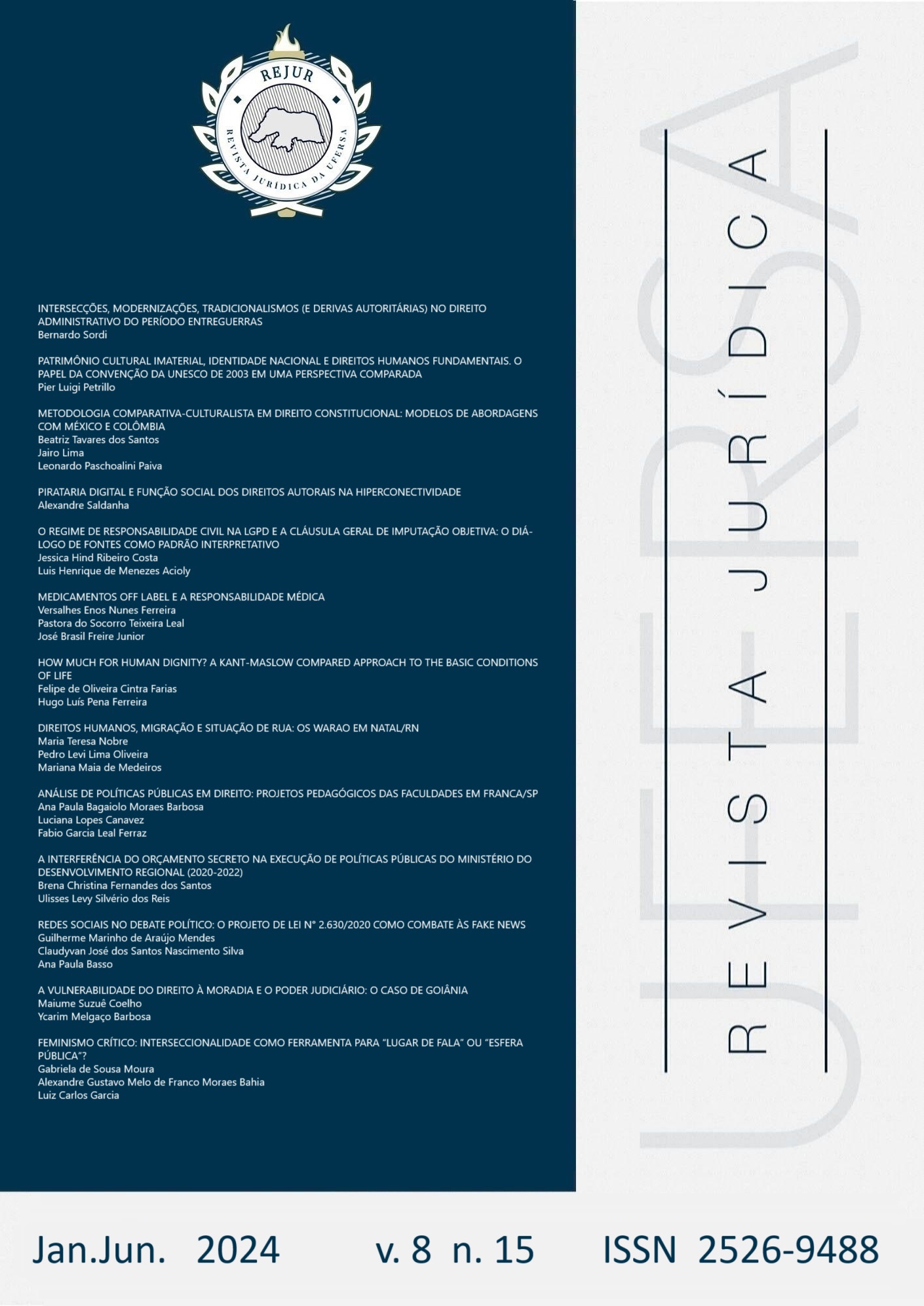
How much for human dignity?
A Kant-Maslow compared approach to the basic conditions of life
DOI:
https://doi.org/10.21708/issn2526-9488.v8.n15.p136-154.2024Abstract
The paper discusses the role of the right to basic conditions of life as a prerequisite for individual autonomy, human dignity, and the possibilities of self-realization. The problem addressed, in this regard, is the tension between formal universal affirmation of human autonomy and dignity and concrete requirements for their coming into being in particular instances, in a world in which human status alone is not enough for the active and material assertion of rights. With this in mind, the study covers Kant and Maslow’s takes on the formation of free will and on the motivators of human behavior, in a comparative approach, in order to understand the role of satisfaction of basic needs, or the basic conditions of life, in the structuring of human dignity in general, and in the formation of free will, in particular. Bibliographic research is the essential technique used to pursue this question. The main contribution sought in this essay is ideational in nature. It is important to have a material understanding of freedom and dignity in contemporary times, in which economic means play a crucial role in overcoming heteronomy through the satisfaction of the basic needs that present themselves as preconditions for autonomy.
Downloads
Published
Issue
Section
License
Copyright (c) 2024 UFERSA's Law Review

This work is licensed under a Creative Commons Attribution-NonCommercial-NoDerivatives 4.0 International License.
Ao enviarem seus artigos, os autores concordam com os seguintes termos: 1. Cede-se à REJUR, gratuitamente e sem regime de exclusividade, seus direitos autorais; 2. Confere-se à REJUR os direitos de primeira publicação, permitindo-se o livre compartilhamento dos artigos veiculados em formato PDF; 3. Divulgações posteriores em periódicos, livros, obras coletivas ou eventos de qualquer natureza devem fazer referência à REJUR como meio de publicação original; 4. Os autores são responsáveis pelo conteúdo constante de seus textos; 5. O trabalho será licenciado também sob a Licença Creative Commons Attribution 4.0 International License (CC-BY).