The History’s Locomotive of time: the radio During the First Getúlio Vargas’s Government – 1930 to 1945
DOI:
https://doi.org/10.21708/issn2526-9488.v6.n11.p23-38.2022Abstract
The radio has played a significant role during Getúlio Vargas’ first government in Brazil – 1930-1945. In addition to being used as a political tool, the radio may have contributed to the perception that the time of events was shortened. This paper aims to analyse whether Reinhart Koselleck’s concept of time acceleration in history could be applied to the use of Radio during that period. By the end of this study, it was found that not only the speed of communications changed due to the new technology, but also its use may have contributed to the rapid social changes that took place. The radio was, in that context, the “locomotive” of time acceleration experience.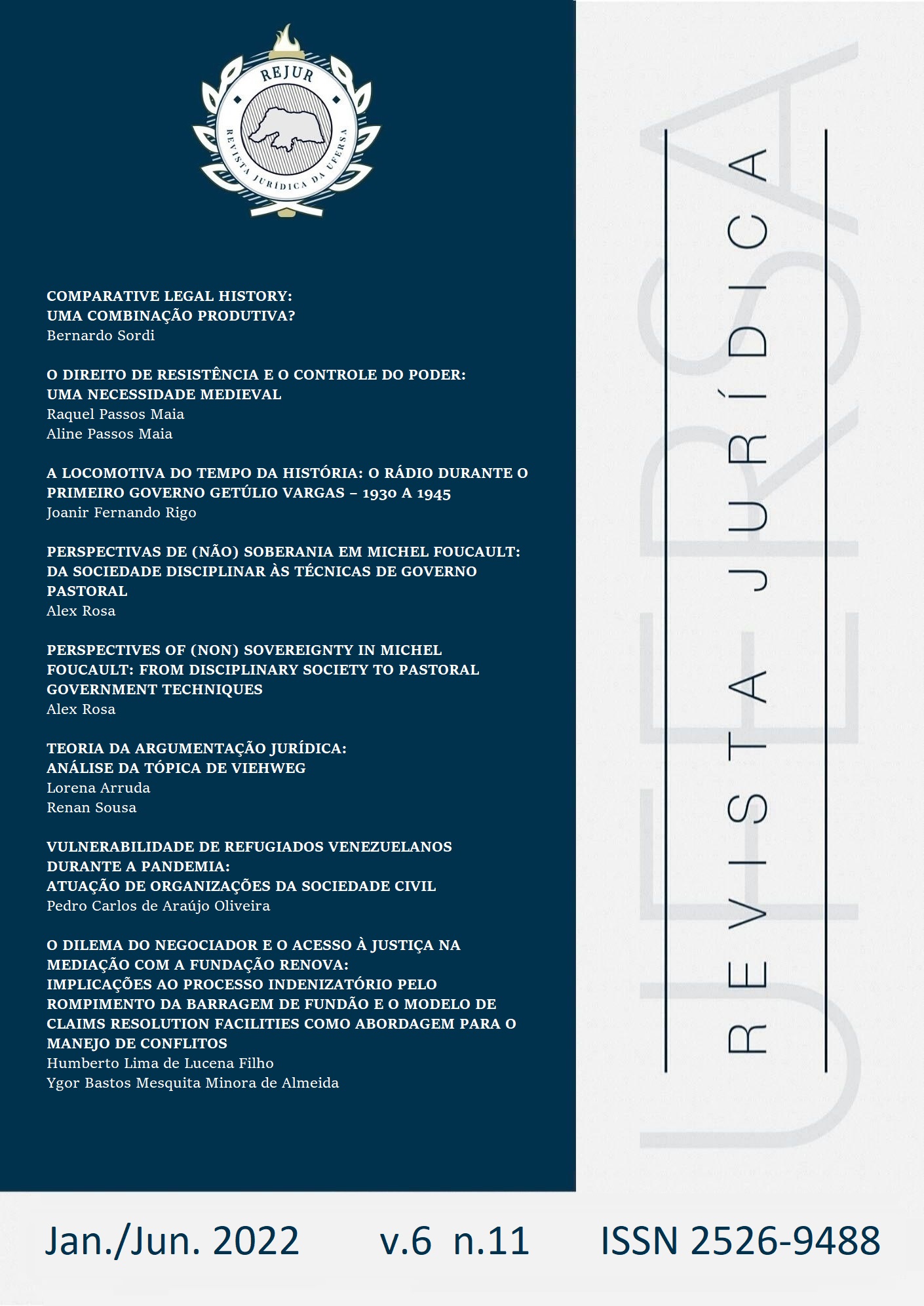
Published
Issue
Section
License
Copyright (c) 2022 UFERSA's Law Review

This work is licensed under a Creative Commons Attribution-NonCommercial-NoDerivatives 4.0 International License.
Ao enviarem seus artigos, os autores concordam com os seguintes termos: 1. Cede-se à REJUR, gratuitamente e sem regime de exclusividade, seus direitos autorais; 2. Confere-se à REJUR os direitos de primeira publicação, permitindo-se o livre compartilhamento dos artigos veiculados em formato PDF; 3. Divulgações posteriores em periódicos, livros, obras coletivas ou eventos de qualquer natureza devem fazer referência à REJUR como meio de publicação original; 4. Os autores são responsáveis pelo conteúdo constante de seus textos; 5. O trabalho será licenciado também sob a Licença Creative Commons Attribution 4.0 International License (CC-BY).