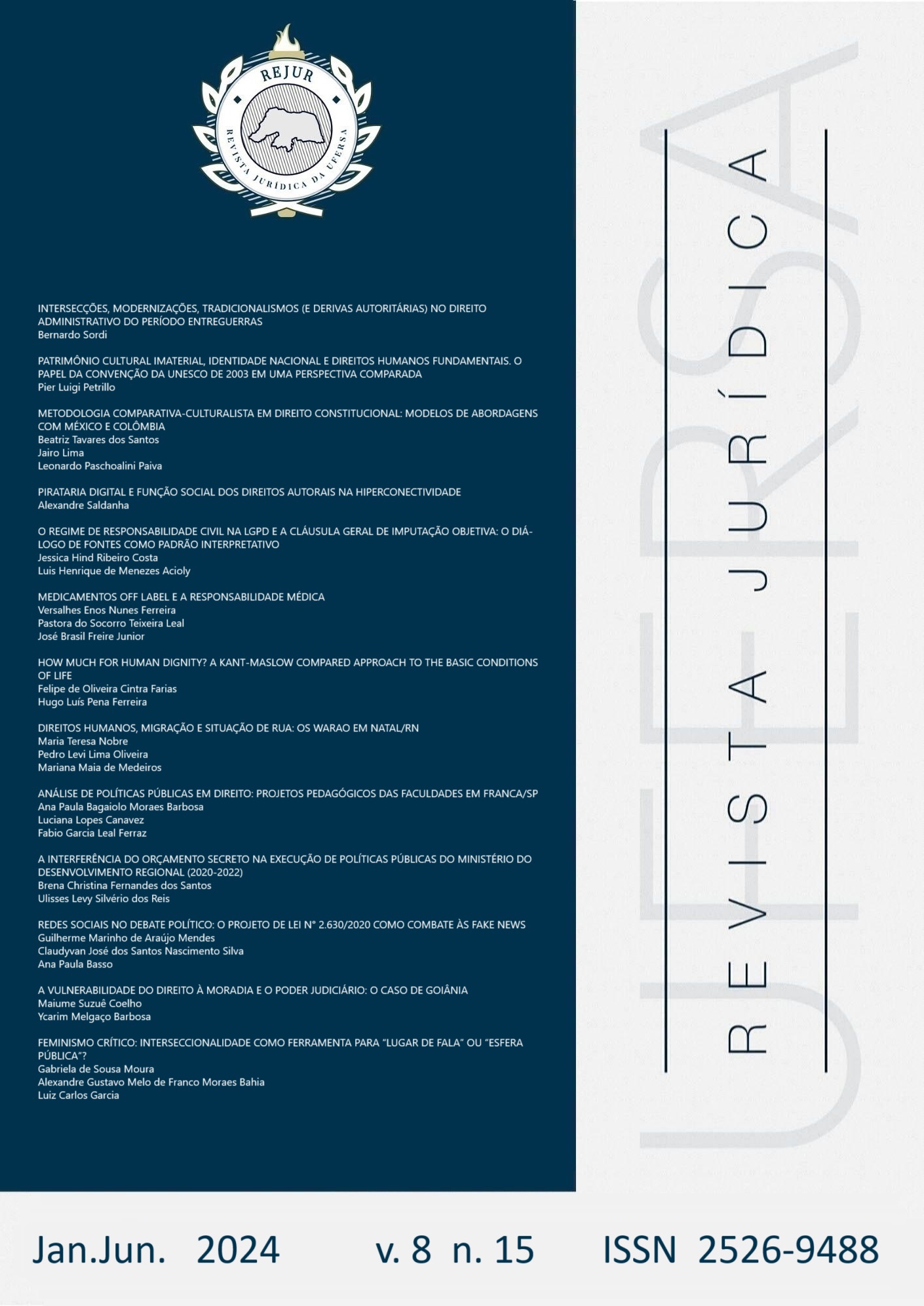
Redes sociais no debate político: o Projeto de Lei n° 2.630/2020 como combate às fake news
DOI:
https://doi.org/10.21708/issn2526-9488.v8.n15.p210-227.2024Abstract
The present work aims to analyze the effects of social networks on the Brazilian political debate, as well as the regulation proposed by Bill No. 2.630/2020, which proposes to combat the spread of “Fake News” on the internet. In democracy, communication is not simply another human interaction, but a form of power. Thus, the speech carries a political load in a dynamic between speakers and listeners, forming audiences that the speaker seeks to persuade. Nowadays, with technological evolution, we are faced with the network society, with interactions that transcend borders, and social networks generate impacts on political life. Phenomena such as “echo chambers”, epistemic bubble and informational disorder appear in the virtual environment and weaken democracy, questioning the need to regulate social networks. Bill No. 2.630/2020 is then analyzed as it proposes to certify transparency, responsibility and freedom on the internet. The work uses the hypothetical-deductive method, with a qualitative approach, with documental analysis and bibliographic review. It is concluded that social networks have influence on political life and it is a new social reality that consequently demands a new specific regulation. PL No. 2,630/2020 proves to be just an initial regulation.
Keywords: Social networks. Policy. Fake News. PL No. 2.630/2020. Regulation.
Published
Issue
Section
License
Copyright (c) 2024 UFERSA's Law Review

This work is licensed under a Creative Commons Attribution-NonCommercial-NoDerivatives 4.0 International License.
Ao enviarem seus artigos, os autores concordam com os seguintes termos: 1. Cede-se à REJUR, gratuitamente e sem regime de exclusividade, seus direitos autorais; 2. Confere-se à REJUR os direitos de primeira publicação, permitindo-se o livre compartilhamento dos artigos veiculados em formato PDF; 3. Divulgações posteriores em periódicos, livros, obras coletivas ou eventos de qualquer natureza devem fazer referência à REJUR como meio de publicação original; 4. Os autores são responsáveis pelo conteúdo constante de seus textos; 5. O trabalho será licenciado também sob a Licença Creative Commons Attribution 4.0 International License (CC-BY).