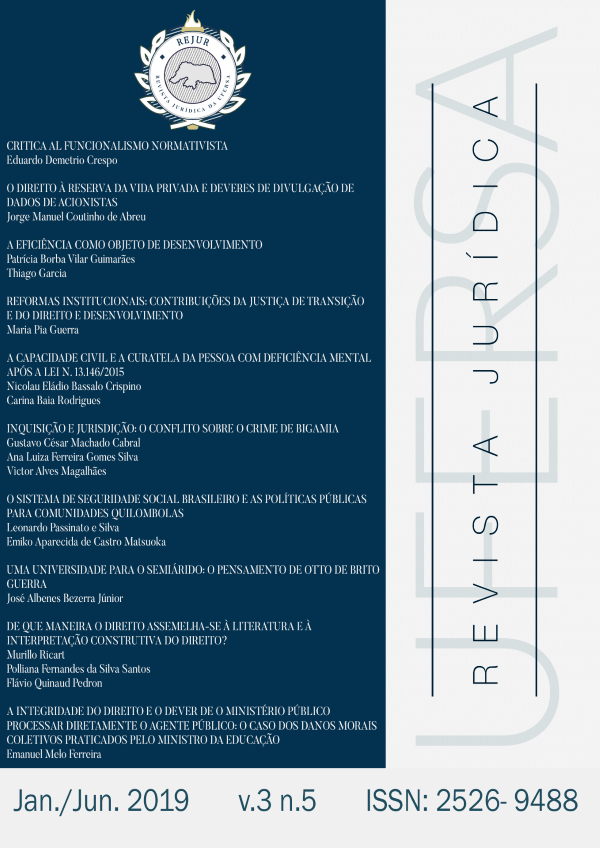
O sistema de seguridade social brasileiro e as políticas públicas para comunidades quilombolas
DOI:
https://doi.org/10.21708/issn2526-9488.v3.n5.p104-119.2019Abstract
ABSTRACT: This article aims to analyze the juxtaposition between Brazilian Social Security system and the public policies addressed to “quilombolas” communities, focusing on the confluences and contradictions between the Social Security framework and “Quilombola” Social Agenda, established by Decree n. 6.261/2007. The lack of a real normative-institutional articulation between these spheres, currently operates as a condition of the concrete difficulties faced by the members of “quilombolas” communities when they search for access to Social Security, mainly in relation to pension benefits, as can be seen in case studies. The article begins with the consecutive exposition of the Social Security structure and the rights related to the “quilombolas” communities in the Brazilian legal system. Subsequently, promotes a reflection concerning the consequences of disarticulation between these regulations. Finally, examines a valuing consideration of a possible meaning of such disarticulation, at the same time that possible guidelines are exposed for a greater institutional suitability.
Keywords: Social Security; “Quilombola” Social Agenda; Social Rights; “Quilombolas” Communities.
Published
Issue
Section
License
Ao enviarem seus artigos, os autores concordam com os seguintes termos: 1. Cede-se à REJUR, gratuitamente e sem regime de exclusividade, seus direitos autorais; 2. Confere-se à REJUR os direitos de primeira publicação, permitindo-se o livre compartilhamento dos artigos veiculados em formato PDF; 3. Divulgações posteriores em periódicos, livros, obras coletivas ou eventos de qualquer natureza devem fazer referência à REJUR como meio de publicação original; 4. Os autores são responsáveis pelo conteúdo constante de seus textos; 5. O trabalho será licenciado também sob a Licença Creative Commons Attribution 4.0 International License (CC-BY).